Call Today! 256-270-9466
Call Today! 256-270-9466
Originally published: October 2026

Warehouse location strategy is the practice of choosing a building based on the freight it will handle and where that freight goes.
Near Huntsville, the choice usually comes down to Huntsville International Airport and Jetplex Industrial Park, the I-565/I-65 interchange, or sites close to daily customers.
The decision works best in three steps: freight type, customer geography, then building feasibility. Dean CRE starts its tenant advisory work with those questions before narrowing the building list.
A warehouse in the wrong corridor adds miles to every shipment. Dean CRE’s free consultation on warehouse space starts with delivery and loading needs.
A Huntsville warehouse search should start with a freight profile: how goods arrive, how they leave, and how far they travel. That profile points to a corridor before anyone tours a building.
Scoring each candidate site on the same three steps keeps the comparison objective.
| Step | What to Score | How to Measure |
| 1. Freight type | Fit with air, rail container, regional truckload, or local delivery freight | Share of annual shipments by mode |
| 2. Customer geography | Drive time to top customers and regional destinations | Peak-hour drive times to the 20 most frequent addresses |
| 3. Building feasibility | Truck court, clear height, loading doors, power, zoning | Pass or fail against operating requirements |
The office-to-warehouse split matters as well. A business with a showroom or engineering staff may fit industrial or flex space better than a pure distribution building, and the building type changes which corridors have inventory.
Importers, exporters, aerospace suppliers, and time-sensitive shippers benefit most from warehouse space near Huntsville International Airport (HSV) because air cargo, rail containers, and customs services sit within one complex.
One public authority, the Port of Huntsville, runs HSV, the International Intermodal Center, Jetplex Industrial Park, and the Spaceport.
Jetplex Industrial Park covers more than 4,000 acres, and the Port of Huntsville lists over 70 companies from 11 countries there, with more than 2,800 acres open for development.
The park has its own I-565 exit and, according to the port’s transportation specifications, shares a property with HSV, which has 12,600-foot and 10,000-foot runways.
The International Intermodal Center (IIC) is an inland port where cargo transfers between rail, truck, and air.
Norfolk Southern runs direct service between the IIC and the East Coast ports of Charleston and Savannah, and West Coast cargo connects through Union Pacific via Memphis.
A foreign-trade zone (FTZ) is a site that U.S. Customs and Border Protection treats as outside U.S. customs territory once CBP activates it, under the Foreign-Trade Zones Act (19 U.S.C. §§ 81a-81u).
Under CBP’s FTZ rules, foreign goods in an activated zone face no formal entry or duty until they enter U.S. commerce for consumption, and goods exported from the zone owe no duty.
Those benefits come with conditions. A building near the airport is not automatically inside Foreign-Trade Zone No. 83, because the site must sit within the zone’s approved boundaries and CBP must activate it before merchandise is admitted.
Merchandise status elections, tariff rules, and restricted product categories also shape the duty owed, so importers should review each transaction with a licensed customs broker before counting duty deferral as a lease-cost offset.
A regional distributor that never touches air freight, rail containers, or imports gains little from the airport complex. Take a building-materials distributor running daily trucks to Birmingham and Nashville: a park near the I-565/I-65 interchange reaches I-65 sooner than Jetplex, and the airport’s cargo and customs services add nothing to that operation.
Dean CRE’s leasing and brokerage team compares Jetplex availability with west-side parks so tenants can weigh both.
I-565 is the east-west spur that links downtown Huntsville, Research Park, and the airport to I-65, the north-south interstate between Birmingham and Nashville.
A warehouse’s distance from that interchange sets how quickly trucks reach regional customers, so corridor choice usually outweighs small rent differences.
ALDOT counts nearly 70,000 vehicles a day on I-565 through Madison, and its widening project between County Line Road and Wall Triana Highway adds a third lane in each direction.
Construction continued through 2026 with completion expected in 2027, so tenants near Exit 9 should check lane and ramp conditions before move-in.
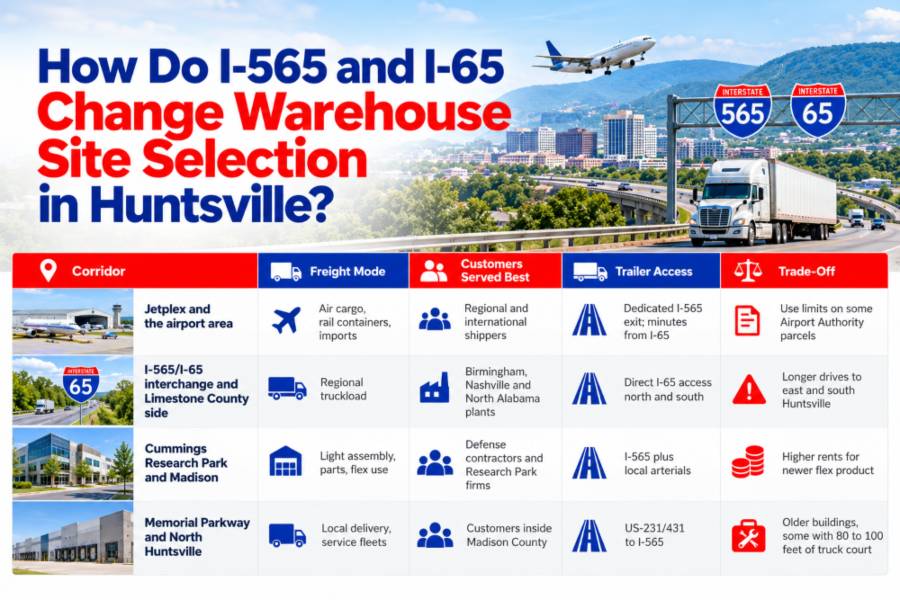
The table compares the four main warehouse corridors.
| Corridor | Freight Mode | Customers Served Best | Trailer Access | Trade-Off |
| Jetplex and the airport area | Air cargo, rail containers, imports | Regional and international shippers | Dedicated I-565 exit; minutes from I-65 | Use limits on some Airport Authority parcels |
| I-565/I-65 interchange and Limestone County side | Regional truckload | Birmingham, Nashville, and North Alabama plants | Direct I-65 access north and south | Longer drives to east and south Huntsville |
| Cummings Research Park and Madison | Light assembly, parts, flex use | Defense contractors and Research Park firms | I-565 plus local arterials | Higher rents for newer flex product |
| Memorial Parkway and North Huntsville | Local delivery, service fleets | Customers inside Madison County | US-231/431 to I-565 | Older buildings, some with 80 to 100 feet of truck court |
Corridor fit narrows the search, but you still need to compare rent, availability, truck routes, and travel time building by building.
A poorly placed warehouse adds haul time to every load for the whole lease. Dean CRE’s warehouse space search weighs delivery routes alongside rent.
If you’re ready to get started, call us now!
From Huntsville International Airport, Birmingham, Chattanooga, Nashville, and Atlanta are all within 150 air miles, while Knoxville and Memphis are beyond it. Distance is only the first test, since same-day routes must also fit federal hours-of-service limits.
Under the FMCSA hours-of-service rules, a property-carrying driver may drive up to 11 hours within a 14-hour window after 10 consecutive hours off duty.
The short-haul exception in 49 CFR § 395.1(e)(1) removes the daily record of duty status under § 395.8 and its supporting documents under § 395.11, but only when every condition is met.
The driver must operate within 150 air miles of the normal work reporting location, return there and be released within 14 consecutive hours, and take at least 10 consecutive hours off between duty periods.
The carrier must also keep time records for six months showing when the driver reported, total hours on duty, and release time.
The exception does not lift the 11-hour driving limit or other hours-of-service rules. An air mile is a nautical mile of 6,076 feet, and the regulation equates 150 air miles with 172.6 statute miles, measured from each driver’s own reporting location.
Distances below are geodesic straight-line figures, rounded to the nearest mile, from the airport terminal, where many Jetplex fleets report for work, to each downtown.
| Destination (Downtown) | Statute Miles From HSV | Air Miles From HSV | Within 150 Air Miles of HSV? |
| Decatur, AL | 12 | 10 | Yes |
| Florence, AL | 53 | 46 | Yes |
| Birmingham, AL | 77 | 67 | Yes |
| Chattanooga, TN | 88 | 76 | Yes |
| Nashville, TN | 105 | 91 | Yes |
| Atlanta, GA | 150 | 130 | Yes |
| Montgomery, AL | 158 | 137 | Yes |
| Knoxville, TN | 185 | 161 | No |
| Memphis, TN | 189 | 164 | No |
Road miles run longer than straight-line distances, and Atlanta round trips can push against the 14-hour limit once you add loading and traffic.
Tenants planning daily Atlanta runs should time a test route from each candidate building before signing a letter of intent, because a site 20 minutes farther from I-65 can turn a one-shift route into an overnight.
Local delivery routes need short drive times to the customers a fleet visits most, and that often matters more than interstate access. A contractor serving Redstone Arsenal, Research Park, and south Huntsville may lose more time crossing town from Jetplex than it saves on the highway.
Redstone Arsenal adds its own constraint. The Arsenal’s access policy routes commercial vehicles through designated gates, and guards inspect every commercial vehicle.
Gate assignments and hours can change, so fleets making regular Arsenal runs should confirm the current commercial gate before building routes around the nearest entrance.
Small fleets often do better in a flex unit with grade-level doors than in a dock-high warehouse. Huntsville flex units along Memorial Parkway and in North Huntsville tend to sit closer to residential and commercial customers.
Asking rents for Huntsville flex listings averaged about $14 per SF per year in June 2026, against asking rents of roughly $9 to $12 per SF for traditional warehouse space.
A hypothetical comparison shows the trade-off. Site A rents for $1 per SF less than Site B on a 30,000 SF lease, saving $30,000 a year, but adds 15 minutes to each of 10 daily delivery runs.
That adds 625 driver hours over 250 working days, and at an assumed $40 per hour covering driver wages, fuel, and truck operating costs, the longer routes cost $25,000 a year before missed delivery windows.
Real route data makes the math concrete: plot the 20 most frequent delivery addresses from the past year and measure peak-hour drive times from each candidate site.
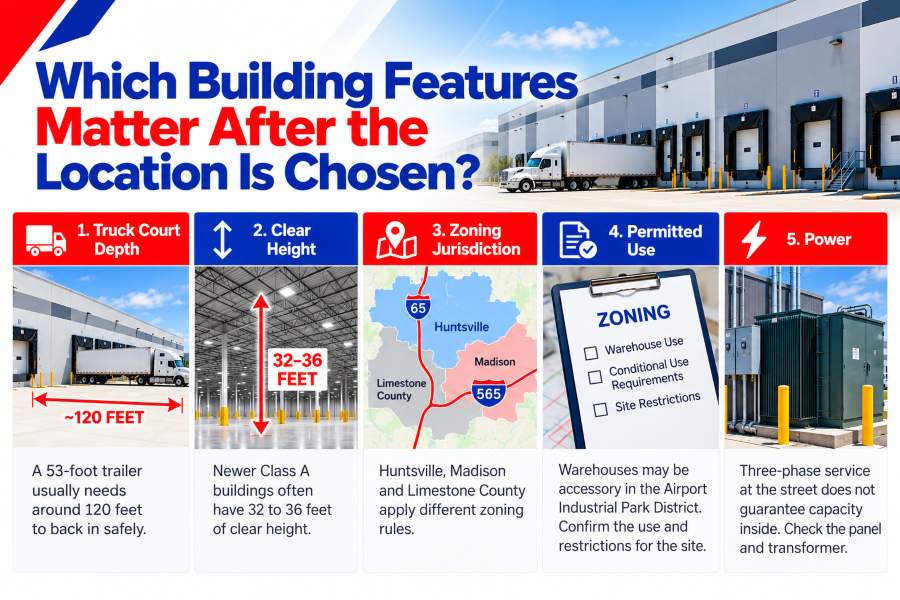
After the corridor is set, truck court depth, clear height, power, and zoning decide whether a specific building works.
Tenants touring several buildings in one day can score each against the same warehouse specifications to keep the comparison consistent. Dock door needs vary with shipment volume, daily trailer turns, and drop-trailer use, so door count should come from a throughput estimate.
Some shortfalls can be fixed with construction, such as added dock doors or upgraded electrical service, and those costs belong in the tenant improvement allowance negotiation. Clear height and truck court depth rarely change after signing.
No. A building qualifies only if it sits within Foreign-Trade Zone No. 83’s approved boundaries and U.S. Customs and Border Protection has activated the site. Product type and status elections also affect duty treatment, so importers should review each transaction with a customs broker.
Sometimes. Downtown Atlanta sits about 130 air miles from Huntsville International Airport, but a same-day round trip must still fit the 11-hour driving limit and 14-hour duty window. Loading time, traffic, and the building’s distance from I-65 decide whether a single shift works.
No. The short-haul exception in 49 CFR § 395.1(e)(1) removes daily logs and supporting documents. Drivers using it must return and be released within 14 hours and take 10 hours off; carriers must keep six months of time records, and the 11-hour driving limit still applies.
Compare the yearly rent difference with the yearly cost of extra driver time on real routes. A site saving $1 per SF on 30,000 SF saves $30,000, but 15 extra minutes on 10 daily runs can cost about $25,000 in driver and truck time.
Traditional warehouse space in Huntsville lists at roughly $9 to $12 per SF in asking base rent, while flex listings averaged about $14 per SF in June 2026. Most industrial leases are triple-net, so taxes, insurance, and maintenance charges add to that base rate.
The widening between County Line Road and Wall Triana Highway remained under construction through 2026, with completion expected in 2027. The project adds a third lane in each direction on a segment carrying nearly 70,000 vehicles a day, so lane shifts affect nearby access.
No. Redstone Arsenal routes commercial vehicles through designated gates, and guards inspect every commercial vehicle on entry. Gate assignments and operating hours can change, so fleets should check the Arsenal’s current access policy before planning delivery routes from a nearby warehouse site.
A tenant-side broker searches for space that fits the operation’s deliveries, loading, and storage needs, previews buildings, contacts landlords, and negotiates lease terms. That screening removes buildings with poor truck access or the wrong zoning before tours, saving site visits and strengthening the negotiating position.
Freight type, customer geography, and building feasibility, in that order, decide where a Huntsville warehouse should sit. Airport-area space pays off for air cargo and imports, regional truckload favors the I-565/I-65 interchange, and local fleets favor sites near daily customers. Birmingham, Chattanooga, Nashville, and Atlanta sit within 150 air miles of the airport, but short-haul eligibility depends on the full set of federal conditions.
Every month in a poorly located warehouse burns driver hours and delivery windows. Dean CRE’s warehouse site consultation matches delivery routes to available Huntsville space.