Call Today! 256-270-9466
Call Today! 256-270-9466
Originally published: September 2026
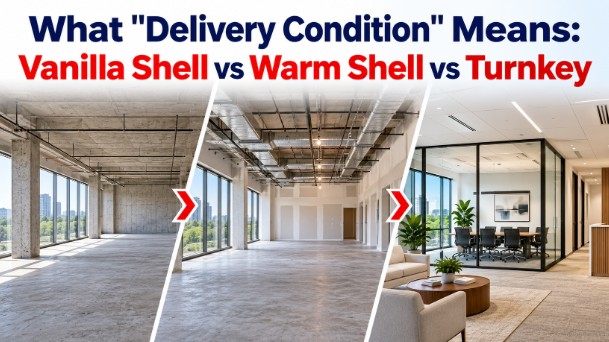
Delivery condition is the lease term that defines the physical state of a commercial space when the landlord hands it to the tenant.
A warm shell has working HVAC, electrical service, and lighting; a vanilla shell adds taped perimeter drywall, a finished ceiling, and restrooms; and a turnkey space arrives fully built out.
Dean CRE’s tenant advisory team reads the landlord work exhibit in each lease before comparing rent across Huntsville spaces, because landlords apply the warm shell and vanilla shell labels inconsistently.
Two suites marketed as vanilla shell can carry different construction bills. Dean CRE compares delivery terms during a free consultation before tenants sign.
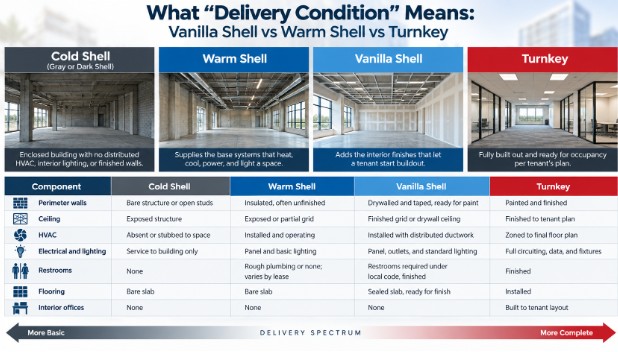
A warm shell supplies the base systems that heat, cool, power, and light a space, while a vanilla shell adds the interior finishes that let a tenant start buildout. Warm shells and vanilla shells sit between a raw cold shell and a finished turnkey suite on the delivery spectrum.
A cold shell, also called a gray or dark shell, is an enclosed building with no distributed HVAC, interior lighting, or finished walls.
The U.S. General Services Administration (GSA) prices federal shell rent around a warm, lit shell with lighting and heating and cooling supplied through normal building operations. The GSA standard gives tenants a public reference point for what “warm” should mean.
The following table compares the components each delivery condition typically includes.
| Component | Cold Shell | Warm Shell | Vanilla Shell | Turnkey |
| Perimeter walls | Bare structure or open studs | Insulated, often unfinished | Drywalled and taped, ready for paint | Painted and finished |
| Ceiling | Exposed structure | Exposed or partial grid | Finished grid or drywall ceiling | Finished to tenant plan |
| HVAC | Absent or stubbed to space | Installed and operating | Installed with distributed ductwork | Zoned to final floor plan |
| Electrical and lighting | Service to building only | Panel and basic lighting | Panel, outlets, and standard lighting | Full circuiting, data, and fixtures |
| Restrooms | None | Rough plumbing or none; varies by lease | Restrooms required under local code, finished | Finished |
| Flooring | Bare slab | Bare slab | Sealed slab, ready for finish | Installed |
| Interior offices | None | None | None | Built to tenant layout |
Landlords in Huntsville and other U.S. markets often treat “warm shell” and “vanilla shell” as interchangeable labels.
Tenants comparing lease rate quotes on two “vanilla shell” suites should confirm that the same components appear in both leases. Confirming matching components keeps a lower quoted rent from hiding a larger buildout bill.
If you’re ready to get started, call us now!
A turnkey space is a suite the landlord builds out to an approved tenant floor plan, with offices, finishes, flooring, and lighting complete before move-in. Turnkey delivery trades a smaller upfront tenant investment for higher base rent across the lease term.
Landlords typically fund turnkey construction and recover the cost by amortizing it into base rent over the initial term.
A tenant that leaves early can owe the unamortized construction balance, so negotiated early termination rights carry more weight in a turnkey lease than in a shell lease.
A second-generation space is a suite that a previous tenant already built out. Landlords sometimes market second-generation suites as move-in ready while the lease delivers the space “as-is,” meaning the tenant accepts existing conditions and pays for every change.
Turnkey delivery fits tenants with standard layouts, fixed opening dates, or limited construction capital.
Turnkey delivery fits poorly for tenants with specialized plumbing, heavy electrical loads, or custom HVAC zoning, because a landlord’s standard build rarely matches those systems and rework delays opening.
Vanilla shell and warm shell definitions change because both terms are market conventions, not standardized definitions, so each landlord writes its own list of delivered items. The work letter attached to the lease controls what the tenant actually receives.
A work letter is a lease exhibit that lists the landlord’s work, tenant’s work, construction standards, and the delivery date. Federal leasing shows how a written standard removes guesswork.
Under GSA leasing guidance, the TI allowance is the budget that carries space from the lease’s warm-lit shell standard to finished usable space. The GSA shell standard applies equally to every offeror.
Tenants should settle delivery items in the letter of intent (LOI), the typically nonbinding proposal that precedes the lease draft, so tenants can compare competing spaces on identical terms:
Tenants who first raise these delivery items after the landlord’s lease draft arrives negotiate against landlord-drafted language on a compressed timeline.
Installed HVAC equipment also raises a separate question about HVAC repair obligations after move-in, which the executed lease language assigns. A commercial real estate attorney should review final work letter language before signing, because clause interpretation is a legal question.
Vague delivery language turns quoted rent into an open-ended construction bill. Dean CRE reads landlord work exhibits when tenants schedule a review before the LOI.
Delivery condition sets how much construction remains after handover, and remaining construction drives a tenant’s out-of-pocket cost. A more finished shell usually carries higher base rent but a smaller tenant-funded buildout.
A tenant improvement allowance (TI allowance) is a landlord-funded budget, usually quoted per SF, that offsets buildout cost.
In North Alabama, TI allowances ranged from $20 to $60 per SF in 2025, and the remaining scope determines whether that budget covers the job.
| Remaining Scope | Typical Work Items | North Alabama Cost (2025) |
| Shallow TI | Paint, flooring, light fixtures, basic millwork | $15–$50/SF |
| Deep TI | Wall relocations, full electrical upgrades, HVAC modifications | $75–$200/SF |
| Medical TI | Specialized plumbing and electrical scope | 30%–40% above standard TI |
A vanilla shell with only shallow work remaining can fit inside a $20–$60/SF allowance. A warm shell needing deep work can leave a funding gap of $15 to $180 per SF.
Tenants can compare the shallow and deep cost bands against the same buildout benchmarks to budget the true cost of each space before signing.
Retail tenants face an added tax question. Under 26 U.S.C. § 110, as of 2026, a tenant in a retail-space lease of 15 years or less can exclude a qualified construction allowance from gross income.
The exclusion applies when the allowance funds nonresidential improvements that revert to the landlord at lease end.
A CPA should confirm the tax treatment before a retail tenant chooses between a cash allowance and landlord-performed turnkey work.
If you’re ready to get started, call us now!
The lease assigns who pays for code, accessibility, and occupancy approvals, but a lease allocation does not change legal responsibility to regulators or the public. Tenants should expect to fund permits for their own buildout, regardless of the shell condition.
The City of Huntsville’s commercial inspection requirements state that a building may not be occupied until final inspections are complete. Huntsville’s inspection requirements also list engineering and subcontractor-list holds that city departments must release before issuing a Certificate of Occupancy.
A tenant opening in a vanilla shell still needs a permitted buildout and occupancy approval, so the landlord’s delivery date is not the tenant’s opening date.
Accessibility creates a second shared obligation. The U.S. Department of Justice’s ADA Title III Technical Assistance Manual states both the landlord and the tenant of a place of public accommodation remain fully liable for ADA compliance. The shared liability applies even when the lease assigns the work to one party.
A lease can shift the cost but not the liability, so retail and medical tenants should confirm shell restrooms, entrances, and paths of travel meet accessibility standards before accepting delivery.
Tenants building out space in Madison follow a separate city process for renovation permits and inspections. Permit timing in Huntsville or Madison should appear in the construction schedule that sets rent commencement.
The best delivery condition depends on how far a tenant’s specifications depart from a standard build. Tenants with standard layouts benefit from vanilla shell or turnkey delivery, while tenants with specialized systems benefit from a warm or cold shell.
Professional office tenants, including aerospace and defense contractors near Cummings Research Park, usually need private offices, conference rooms, and data cabling rather than specialized plumbing.
A vanilla shell or turnkey suite typically fits office users, so office tenants can avoid funding deep TI work. Security requirements such as sound attenuation or access control belong in the work letter, not in a later change order.
Medical tenants often need plumbing at exam rooms, higher electrical loads, and tighter HVAC control than a standard warm shell provides.
Buildout in existing medical office space with plumbing already in place usually costs less than converting a standard office shell.
Medical users should compare second-generation medical suites against new vanilla shells before choosing.
Retail tenants in Huntsville shopping centers commonly accept vanilla shell delivery and fund signage, fixtures, and finishes themselves. Vanilla shell delivery means retail tenants can put construction dollars into customer-facing finishes instead of base building systems.
Restaurant users usually prefer a cold or warm shell, because grease interceptors, hood exhaust, and gas service rarely match a landlord’s standard vanilla build.
Flex tenants combine office use with warehouse or light-industrial use in buildings designed for minimal buildout.
TI allowances for flex space in Huntsville and Madison generally ran $3 to $10 per SF in 2026. Flex users should therefore negotiate delivered items such as office finish, dock equipment, and electrical capacity rather than rely on allowance dollars.
Is a vanilla shell the same as a white box?
A vanilla shell and a white box usually describe the same delivery condition: finished perimeter drywall, a ceiling, lighting, HVAC, and restrooms, with no interior offices or finishes. Landlords define vanilla shell and white box differently, so the work letter controls what each lease delivers.
Does a warm shell include restrooms?
A warm shell does not always include finished restrooms. Warm shell leases frequently deliver only rough plumbing stubs, while a vanilla shell often includes restrooms required under local code. Tenants should confirm restroom count, fixture installation, and accessibility compliance in the work letter before signing.
What is a cold dark shell in commercial real estate?
Cold dark shell space arrives enclosed but without distributed HVAC, interior lighting, finished walls, or restrooms. Cold shell space usually carries the lowest base rent but requires the most tenant-funded construction, which suits restaurants, medical users, and industrial tenants with specialized systems.
Who pays to finish a vanilla shell space?
The tenant usually pays to finish a vanilla shell space, often with help from a landlord-funded TI allowance. In North Alabama, TI allowances ranged from $20 to $60 per SF in 2025, and the lease defines which costs the allowance covers.
Is turnkey commercial space more expensive to lease?
Turnkey commercial space usually carries a higher base rent than shell space because the landlord funds construction and amortizes that cost into rent. Tenants spend less upfront, but total lease-term occupancy cost can exceed the total cost of leasing shell space and funding the buildout.
How long does it take to build out a vanilla shell?
Vanilla shell buildout time depends on design approval, permit review, contractor availability, and inspection scheduling, not the shell label alone. Huntsville tenants should obtain a written construction and permitting schedule before agreeing to a rent commencement date tied to delivery.
Can a tenant negotiate a better delivery condition?
A tenant can negotiate a better delivery condition, especially before the lease draft exists. Tenants commonly request added HVAC distribution, finished restrooms, upgraded electrical service, or a larger TI allowance in the LOI, and landlords weigh those requests against lease term and tenant credit.
Does a tenant need a certificate of occupancy for shell space in Huntsville?
A tenant building out shell space in Huntsville generally needs final inspections and a Certificate of Occupancy before opening. The City of Huntsville states that a building may not be occupied until final inspections are complete, so landlord delivery does not authorize occupancy.
A mislabeled shell can leave a tenant funding deep buildout beyond the allowance. Call Dean CRE at (256) 270-9466 to review the work letter first.