Call Today! 256-270-9466
Call Today! 256-270-9466
Originally published: May 2026 | Updated: September 2026

Commercial tenants in Alabama who sign a standard lease without a negotiated exit mechanism are contractually obligated to pay base rent, operating expenses, and CAM charges through the full lease term — even if the business closes, revenue collapses, or the leased space becomes operationally unsuitable.
An early termination clause and a kick-out right are two legally distinct contractual mechanisms that allow a commercial tenant to exit a lease before expiration without defaulting.
An early termination clause is elective — the tenant pays a defined fee and exits. A kick-out right is conditional — the tenant exits when a defined performance threshold fails, typically without a termination fee. Neither clause appears in a standard Alabama commercial lease by default; both must be negotiated before the lease is signed.
An early termination clause is a contractual lease provision that gives a commercial tenant the right to exit the lease before the expiration date by delivering written notice to the landlord within a defined window and paying a predetermined termination fee.
An early termination clause converts an otherwise unconditional multi-year rent obligation into a defined, calculable exit cost — so you can make a financially controlled decision to vacate rather than defaulting on the lease and triggering full rent acceleration under Alabama Code § 35-9A-421.
Alabama commercial leases do not include early termination clauses by default. A landlord drafting the lease has no financial incentive to include an exit mechanism that reduces rent certainty over a 3–10-year lease term.
A tenant who signs without representation and without requesting an early termination clause has no contractual path out of the lease short of default, subletting with the landlord’s consent, or negotiating a lease buyout at the landlord’s unilateral discretion and pricing.
An early termination clause differs from a lease default in one legally critical respect. Termination under a negotiated clause is a contractual right exercised in good standing — the tenant pays the defined fee, delivers notice within the required window, and exits with no further rent liability.
A lease default triggers the landlord’s right to accelerate the full remaining rent obligation, recover unamortized tenant improvement allowance costs and leasing commissions, and pursue the tenant for damages under Alabama Code § 35-9A-421 — a financial exposure that reaches six or seven figures on a 5–10 year commercial lease in the Huntsville, Alabama market.
Tenants negotiating commercial leases in Alabama should treat an early termination clause as a core lease term — not an optional contingency — in any lease exceeding three years.
If you’re ready to get started, call us now!
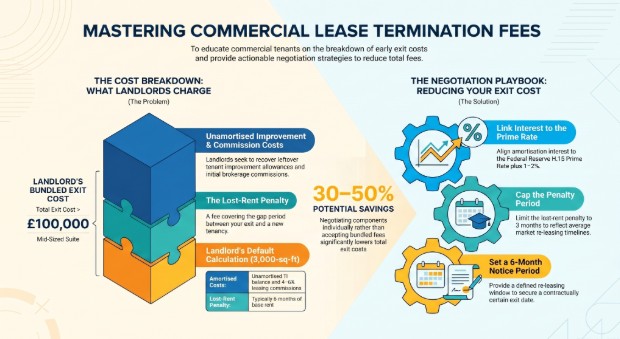
A commercial lease early termination fee is the financial consideration a tenant pays the landlord to exercise a negotiated right to terminate the lease early.
Landlords structure termination fees to recover three specific cost categories: the unamortized tenant improvement allowance, the unamortized leasing commissions paid at lease inception, and a lost-rent penalty covering the landlord’s re-leasing gap period.
Tenants who negotiate each component individually — rather than accepting the landlord’s bundled fee proposal — reduce total exit cost by 30–50% in most Huntsville commercial lease transactions.
On a 5-year lease with a $50-per-square-foot tenant improvement allowance on a 3,000-square-foot suite, the unamortized TI balance alone exceeds $60,000 at the lease midpoint — before the lost-rent penalty is calculated.
Adding unamortized leasing commissions (typically 4–6% of total lease value under standard CCIM Institute brokerage fee structures) and a 6-month lost-rent penalty on a $6,000-per-month suite produces a total termination fee exceeding $120,000 under the landlord’s default calculation method.
Tenants should negotiate three specific modifications to reduce that total. First, the amortization interest rate applied to TI and commission balances should reference the U.S. Federal Reserve H.15 Prime Rate plus 1–2% — not an inflated landlord-proposed rate that accelerates the unamortized balance beyond actual carrying cost.
Second, the lost-rent penalty period should be capped at 3 months rather than 6, reflecting the documented average re-leasing timeline in the Huntsville commercial submarket.
Third, the tenant’s advance notice period should be set at 6 months — giving the landlord a defined re-leasing window while giving the tenant a contractually certain exit date.
Anchoring these three terms in the commercial lease letter of intent ensures each provision appears in the first lease draft before the landlord’s attorney establishes the fee structure. The lease structure type also affects the total termination cost — a triple-net tenant owes operating expenses and property tax contributions for the full notice period, in addition to the base rent penalty.
Understanding how CAM charges compound the termination fee calculation prevents a tenant from underestimating the total exit cost at the time of exercise.
A kick-out right is a performance-based commercial lease exit clause that allows a tenant to terminate the lease when a defined business metric — typically gross sales revenue, customer traffic count, or co-tenancy occupancy percentage — falls below a contractually specified threshold for a defined consecutive measurement period.
Kick-out rights originated in U.S. retail leasing during the 1980s shopping center expansion period and remain most common in shopping center, strip mall, and anchor-dependent retail leases.
The clause structure applies to any Alabama commercial tenant whose business performance is demonstrably and measurably tied to a specific location’s foot traffic or co-tenant mix.
A kick-out right differs from an early termination clause in one fundamental structural respect: a kick-out right is conditional rather than elective. A tenant exercising an early termination clause pays a predetermined fee and exits at a date of the tenant’s choosing, regardless of business performance.
A tenant exercising a kick-out right exits because a defined performance condition has objectively failed — and a properly drafted kick-out clause imposes no termination fee when the performance threshold triggers the exit, because the landlord’s failure to maintain the conditions supporting the tenant’s revenue projections eliminates the landlord’s claim to a penalty.
Kick-out clauses require precise drafting across four contractual components to withstand landlord disputes.
The performance metric must be specific and independently verifiable — gross sales revenue documented in point-of-sale system records, not self-reported estimates or projections. The revenue threshold must be defined in exact dollar terms — for example, gross monthly sales below $45,000 for three consecutive calendar months — rather than a subjective “insufficient revenue” standard that creates disputed interpretation.
The measurement period must span at least 12 consecutive months to exclude seasonal sales variation, using trailing 12-month revenue benchmarks aligned with the U.S. Census Bureau’s Monthly Retail Trade Survey data for the relevant merchandise category.
The landlord’s cure period must give the landlord 60–90 days to restore co-tenancy occupancy or address traffic conditions before the kick-out right activates, so you can demonstrate good-faith notice before exercising the exit.
Huntsville commercial tenants in retail corridors along University Drive NW and Research Park Boulevard should include kick-out rights in any lease tied to a named anchor tenant’s continued occupancy.
A co-tenancy clause is a commercial lease provision that reduces a tenant’s base rent obligation — or activates a pre-negotiated kick-out right — when a named anchor tenant vacates or when building occupancy falls below a contractually specified minimum percentage.
Co-tenancy clauses protect retail tenants whose foot traffic, customer acquisition, and gross sales volume depend directly on the continued presence of specific anchor tenants or a minimum building occupancy level.
The International Council of Shopping Centers (ICSC) identifies co-tenancy clause failures as one of the most frequently litigated categories of commercial lease disputes in U.S. retail markets.
A Huntsville strip mall tenant on University Drive NW who signed a lease based on a named anchor retailer’s presence faces a measurably different revenue trajectory if that anchor closes before the lease expires — and a tenant without a co-tenancy clause holds no contractual rent relief or exit remedy during the anchor vacancy period.
A co-tenancy clause must specify four enforceable components: the named anchor tenant or tenants whose continued occupancy triggers the protection; the minimum building occupancy percentage below which the rent reduction activates, typically 80% of net leasable area; the base rent reduction percentage that applies during the co-tenancy failure period, typically 25–50% of contracted base rent; and the consecutive failure duration — typically 6–12 months — after which the kick-out right activates if the landlord has not restored the co-tenancy condition.
Negotiating a co-tenancy clause and a kick-out right together in the commercial lease letter of intent creates a two-stage protection: rent relief during the co-tenancy failure period, and a penalty-free exit if the landlord fails to restore the condition within the contractual cure window — so you can manage revenue loss during the failure period without committing to full rent through the lease term.
If you’re ready to get started, call us now!
Landlords routinely embed four conditions in early-termination and kick-out clauses that narrow or eliminate the tenant’s ability to exercise the right to exit. Each restriction is negotiable at the Letter of Intent stage and becomes a fixed, non-negotiable term of the lease upon execution.
A good-standing requirement voids the early-termination right if the tenant has any uncured default at the time of exercise, including unresolved CAM reconciliation disputes or outstanding maintenance reimbursement claims.
Tenants should negotiate “no uncured material default at the time of exercise” as the controlling standard, replacing “no default” language, so a disputed $500 CAM charge cannot eliminate a $120,000 early termination right.
A blackout period is a landlord-imposed restriction that prohibits the exercise of the early termination right during the first 24–36 months of the lease term, protecting the landlord’s recovery of upfront TI and commission costs.
Tenants should negotiate a blackout period of 12–18 months on a standard 5-year lease, so the exit window opens in year two rather than year three, before a deteriorating revenue trajectory becomes a balance sheet crisis.
A personal-to-tenant restriction voids the early termination right upon any lease assignment, business acquisition, corporate merger, or entity restructuring.
A tenant with a private equity growth plan or a realistic acquisition timeline should negotiate the explicit transferability of the early termination right alongside the assignability of the renewal option, so that a business sale does not simultaneously eliminate the acquiring entity’s exit mechanism.
A re-leasing contingency conditions the tenant’s exit on the landlord’s successful execution of a signed replacement lease before the termination takes effect — giving the landlord a functional veto over the tenant’s exit date.
Tenants should reject re-leasing contingencies entirely, or negotiate a maximum 90-day extension of the termination effective date as the only landlord remedy.
Commercial lease representation through a dedicated tenant broker identifies and eliminates each of these four restrictions before lease signing, so you can exercise exit rights on your timeline rather than the landlord’s replacement leasing schedule.
Tenants who address these restrictions at the LOI stage — rather than discovering them post-signing — avoid the most costly commercial real estate mistakes in Alabama and exit leases at measurably lower cost when business conditions require it.
Tenant representation in Huntsville addresses early termination fees, kick-out thresholds, co-tenancy conditions, and landlord restrictions at the Letter of Intent stage — before the landlord’s attorney drafts a single exit clause.
A tenant broker experienced in Huntsville commercial lease negotiation who represents tenants exclusively structures the LOI to specify the termination fee formula, the amortization rate reference, the notice period, the blackout window, assignability language, and the explicit absence of any re-leasing contingency — so the first lease draft reflects the tenant’s exit framework rather than the landlord’s default restrictions.
Dean CRE, led by principal broker Dean Greer, CCIM, provides exclusive tenant representation across Huntsville and North Alabama’s commercial real estate market. Dean Greer holds the Certified Commercial Investment Member (CCIM) designation from the CCIM Institute — the commercial real estate industry’s credentialing standard for lease negotiation, investment analysis, and market valuation.
Every Dean CRE lease engagement includes a structured, clause-by-clause audit of early termination and kick-out language before any lease document is executed.
If your North Alabama commercial lease contains no early termination clause, or if you are entering initial lease negotiations and need exit protections built into the LOI before the landlord sets default terms, contact Dean CRE before the lease draft is written.
What is an early termination clause in a commercial lease?
An early termination clause is a contractual lease provision that gives a commercial tenant the right to exit the lease before its expiration by providing written notice within a defined window and paying a predetermined termination fee. The clause replaces an unconditional multi-year rent obligation with a defined, calculable exit cost that the tenant controls.
What is a kick-out right in a commercial lease?
A kick-out right is a performance-based exit clause that allows a commercial tenant to terminate a lease when a defined business metric — typically gross sales revenue or customer traffic count — falls below a specified threshold over a defined consecutive measurement period. A properly drafted kick-out clause imposes no termination fee when the performance condition is triggered.
What is the difference between early termination and lease default in Alabama?
An early termination clause is a contractual right exercised in good standing — the tenant pays a defined fee and exits with no further rent liability. A lease default triggers rent acceleration and full damage recovery under Alabama Code § 35-9A-421, producing financial exposure that can exceed six figures on a multi-year Huntsville commercial lease.
How is a commercial lease’s early termination fee calculated?
A standard termination fee covers the unamortized tenant improvement allowance, unamortized leasing commissions, and 3–6 months of base rent as a lost-income penalty. Tenants should negotiate the amortization rate against the U.S. Federal Reserve H.15 Prime Rate plus a 1–2% market margin, cap the lost-rent penalty at 3 months, and require 6 months advance notice to minimize total exit cost.
What is a co-tenancy clause, and how does it relate to kick-out rights?
A co-tenancy clause is a lease provision that reduces base rent — or activates a kick-out right — when a named anchor tenant vacates or building occupancy falls below a defined minimum, typically 80% of net leasable area. A co-tenancy clause provides rent relief during the failure period; the associated kick-out right provides a penalty-free exit if the landlord fails to restore the co-tenancy condition within the contractual cure window.
Can a landlord in Alabama refuse to include an early termination clause?
Yes. Alabama commercial leases operate under contract law — no Alabama statute requires a landlord to include early-termination rights in a commercial lease. A tenant broker with documented Huntsville submarket vacancy data demonstrates re-leasing feasibility to the landlord, providing the factual basis for accepting exit terms and converting a discretionary landlord decision into a market-supported negotiation.
What is a blackout period in an early termination clause?
A blackout period is a landlord-imposed lease restriction that prohibits the exercise of the early termination right during the first 24–36 months of the lease term, protecting the landlord’s recovery of the upfront TI allowance and leasing commission costs. Tenants should negotiate a 12–18-month blackout period on a standard 5-year lease, so the exit window opens in year 2, before a deteriorating revenue trajectory reaches a balance sheet crisis.
What happens if a tenant defaults on an Alabama commercial lease instead of exercising a termination clause?
A defaulting Alabama commercial tenant faces acceleration of the full remaining rent obligation, recovery of unamortized tenant improvement costs and leasing commissions, and potential attorney fee liability under Alabama Code § 35-9A-421. The landlord must mitigate damages by attempting to re-lease the space under Alabama contract law, but the defaulting tenant remains liable for the full rent gap between the contracted rate and any replacement rent the landlord achieves.