Call Today! 256-270-9466
Call Today! 256-270-9466
Originally published: October 2026
Commercial lease red flags are clauses that look routine at signing but shift future costs, risk, or lost flexibility onto the tenant. The most expensive ones usually sit in operating-cost pass-throughs, repair duties, exit and transfer rights, and personal guarantees.
Most can be narrowed at the letter-of-intent stage, before the landlord’s attorney drafts the full lease.
Dean CRE’s tenant advisory team negotiates these business terms, while a commercial real estate attorney confirms how each clause reads under Alabama law.
Lease terms are cheapest to change before you sign the letter of intent. Dean CRE offers a free consultation on business terms before any commitment.
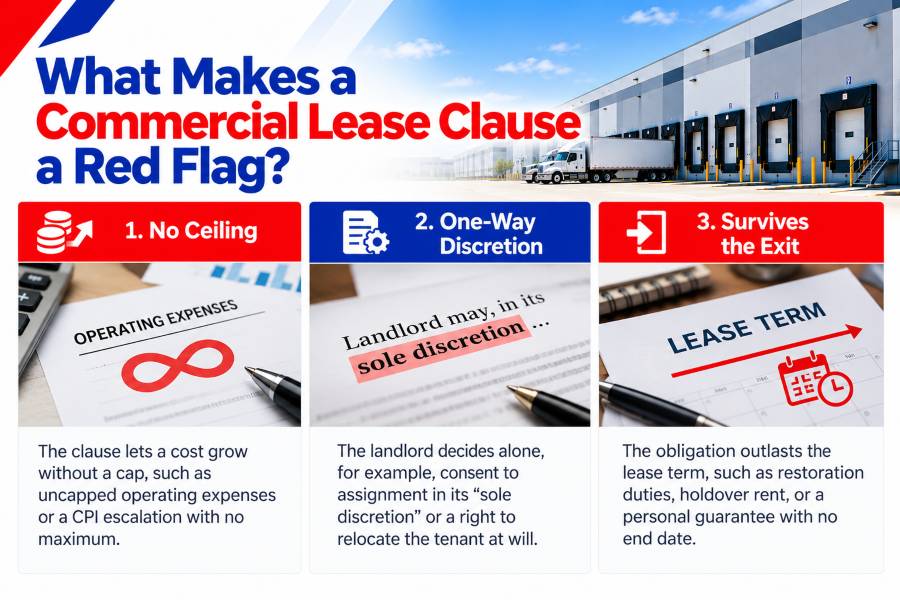
A clause becomes a red flag when it creates an open-ended cost or obligation the tenant cannot price at signing. Three tests help sort routine language from risky language:
When bargaining power is limited, priorities matter. Terms that expose personal assets without limit, such as an unlimited guarantee paired with rent acceleration, belong at the top of the list and may justify walking away.
Cost terms such as CAM caps, holdover rates, and relocation rights come next, since they can often be traded against each other, while signage rules and similar items usually follow the building’s standard form.
A landlord-favorable term is not automatically a deal-breaker. Accepting a CPI escalation or a longer guarantee can make sense in exchange for lower base rent, a larger improvement allowance, or free rent, as long as the tenant prices the trade.
Reading the rate quote next to the lease draft shows which costs sit outside base rent.
Operating-cost clauses hide the biggest bills because they reset every year and rarely carry a ceiling unless the tenant asks for one. Under a triple-net (NNN) lease, the tenant pays a pro rata share of taxes, insurance, and common area maintenance (CAM) in addition to base rent.
A pro rata share is the tenant’s percentage of the building, so a 5,000 SF suite in a 50,000 SF building carries 10% of shared costs.
Red flags include no annual cap on controllable expenses, a management fee charged as a percentage on top of actual costs, and capital projects such as roof replacement passed through as operating expense. A lease with no CAM audit right leaves the tenant paying the annual true-up without seeing the receipts.
In a hypothetical case, controllable CAM starts at $20,000 a year. Growing 8% a year uncapped, it reaches $27,210 in year five and totals $117,332 over five years. A 5% cap holds year five to $24,310 and the five-year total to $110,513, a $6,819 difference.
Dean CRE’s North Alabama lease work points to two local patterns. Many Huntsville buildings from the 1980s and 1990s face major updates that landlords may try to bill as CAM.
Corridors such as Memorial Parkway and University Drive also tend to carry higher CAM because of landscaping and parking upkeep, so every comparison should include an itemized expense history.
A CPI escalation ties annual rent increases to the Consumer Price Index instead of a fixed percentage.
According to the Bureau of Labor Statistics, consumer prices rose 9.1% over the year ended June 2022. On $25,000 of hypothetical annual base rent, a 9.1% adjustment adds $2,275 in one year, against $750 under a fixed 3% bump, so a cap and a floor keep increases inside a known band.
If you’re ready to get started, call us now!
Repair and compliance clauses shift landlord costs when they assign “all repairs and replacements” or “compliance with all laws” to the tenant without limits. Those phrases can make the tenant pay for a new HVAC unit, roof work, or building-wide code upgrades.
Routine maintenance and full replacement are different obligations. A tenant can reasonably service the rooftop HVAC unit, but replacing a 15-year-old unit in year two benefits the landlord for decades.
Strong language caps the tenant’s share of any single replacement or amortizes it over the equipment’s useful life, charging only the portion within the lease term.
The split for HVAC and roof repairs should be in writing and include a dollar threshold.
A broad compliance clause can make the tenant pay for accessibility work, fire-code upgrades, or changes triggered by a buildout permit.
For a place of public accommodation, 28 CFR § 36.201(b) makes both landlord and tenant subject to ADA Title III, and the Department of Justice ADA Title III manual explains that a lease allocation binds only the two parties.
Regulators can still pursue either party, and the lease only decides who reimburses whom.
Tenants should limit their compliance duty to their own premises and specific use, and leave common areas and pre-existing violations with the landlord.
An “as-is” clause means the tenant accepts the current condition, including hidden defects discovered after move-in.
Commercial work in Huntsville requires ePlans review for a building permit, plus separate electrical, plumbing, and mechanical trade permits, and that review can expose older systems that must meet current code.
A restoration clause can also require the tenant to remove its improvements and return the space to shell condition at lease end.
A broad repair clause can cost more than the whole build-out allowance. Dean CRE’s lease negotiation work sets the repair split before the draft arrives.
Exit and transfer clauses trap a tenant when they block a sale, sublease, or early exit and then penalize the tenant for staying past expiration.
| Clause | Red-Flag Version | Possible Negotiating Position |
| Assignment and subletting | Landlord consent in its “sole discretion” | Consent “not to be unreasonably withheld, conditioned or delayed,” with a response deadline |
| Recapture | Landlord may cancel the lease when the tenant asks to sublease | Recapture limited to full-space transfers, or waived for affiliate and sale-of-business transfers |
| Relocation | Landlord may move the tenant to “comparable” space at any time | Same size and finish, landlord pays moving, signage, and IT costs, tenant may terminate instead |
| Holdover | Rent jumps to a steep multiple of the final rent from day one | A smaller premium for a short grace period, with damages limited to actual losses |
| Early termination | No exit right during the term | A kick-out right at a set date with a defined fee |
How far a landlord moves on any row depends on tenant credit, property type, and market conditions.
Holdover costs add up quickly: under a hypothetical lease with $8,333 monthly rent and a 150% holdover rate, three extra months cost $12,500 more than the old rent.
Transfers carry a separate trap. An assignment or sublease moves the space to someone else, but neither, by itself, ends the original tenant’s liability.
Release usually requires the landlord’s express written agreement, often called a release or novation, so a tenant selling its business should negotiate that release as part of the landlord’s consent.
Guarantee and default terms put personal assets at risk when an owner signs an unlimited personal guarantee or when a single missed payment triggers acceleration of all future rent. A personal guarantee is a separate contract in which the owner promises to pay the company’s lease obligations personally.
That promise differs from piercing the corporate veil, a court doctrine that can disregard an LLC or corporation in limited cases.
The company structure still shields the owner from other business debts, but the guarantee creates direct personal liability for whatever the guarantee covers.
| Term | Red-Flag Version | Possible Negotiating Position |
| Personal guarantee | Full guarantee for the entire term with no dollar or time limit | A dollar cap, such as several months of rent, or a burn-off after a run of on-time payments |
| Security deposit | Large deposit held with no return deadline | Deposit sized to credit history, returned within a set number of days after surrender |
| Default and cure | Default on any late payment with no notice | Written notice and a cure period for monetary and non-monetary defaults |
| Acceleration | All remaining rent due immediately after default | Damages tied to actual losses, with the landlord’s duty to re-let addressed in the lease |
| Confession of judgment | Tenant pre-agrees to a judgment without a hearing | Struck from the draft, since Ala. Code § 8-9-11 voids pre-suit agreements to confess judgment |
A good-guy clause is a limited guarantee that ends the guarantor’s liability once the tenant gives notice, pays rent through the surrender date, and returns the keys.
Whether a landlord accepts a capped personal guarantee, a burn-off, or a good-guy clause depends on the tenant’s financials and the landlord’s risk. Attorney-fee clauses that run only in the landlord’s favor deserve the same scrutiny.
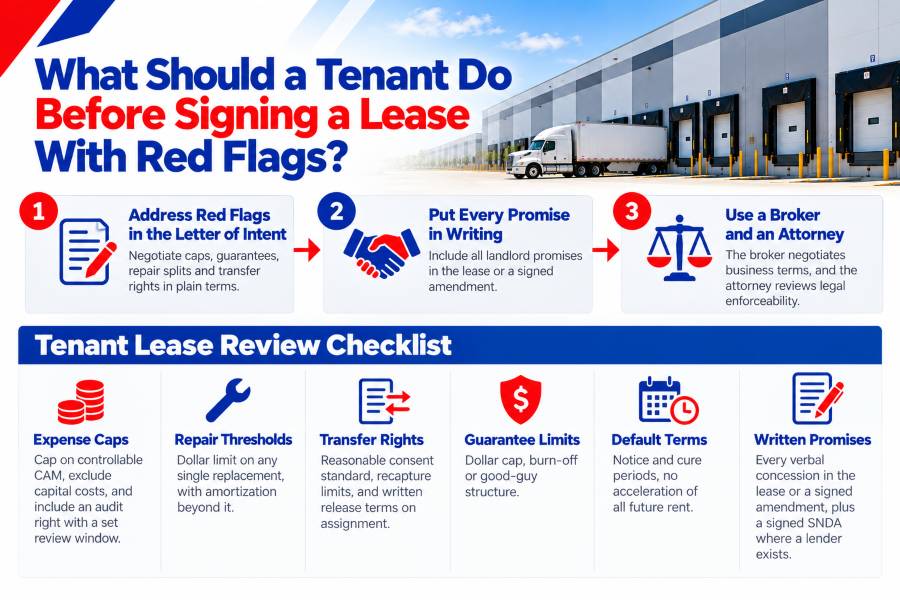
A tenant should push the biggest red flags into the letter of intent, get every landlord promise into the lease, and split the review between a tenant-side broker and an attorney.
The broker negotiates business terms such as rent, caps, guarantees, and transfer rights, while the attorney reviews legal enforceability.
Caps, guarantee limits, repair splits, and transfer rights belong in the letter of intent, written in plain terms. Points settled there become the baseline for the lease draft, so raising a red flag later means negotiating against terms both sides already accepted.
Spoken promises create a separate risk. Alabama’s statute of frauds, Ala. Code § 8-9-2, generally requires a signed writing for land interests beyond one-year leases, and most commercial leases add an entire-agreement clause.
A landlord’s verbal offer to repaint, add parking, or waive a fee should appear in the lease or a signed amendment.
A subordination, non-disturbance, and attornment agreement (SNDA) can protect occupancy if the landlord’s lender forecloses. Still, only if the lender signs it, the tenant is not in default, and the SNDA is on its written terms. Lenders are not required to give non-disturbance, so tenants should request it before signing.
Yes. Office tenants usually face operating-expense and relocation clauses, retail tenants add co-tenancy, exclusive-use, and percentage-rent terms, and industrial tenants carry heavier repair, roof, and environmental duties under NNN structures. The same three tests apply to every one of these property types.
Yes, if the lease contains a relocation clause. Tenants should seek comparable size and finish, landlord payment of moving, signage, and technology costs, limited timing, and a right to terminate instead of moving when the replacement space does not fit the business.
A CAM cap limits yearly increases in controllable operating expenses, such as janitorial or landscaping, to a set percentage. Taxes and insurance usually stay outside the cap, so tenants should also request audit rights and a clear list of excluded capital costs.
Not automatically. An assignment transfers the lease to a new tenant, but the original tenant usually stays liable unless the landlord signs an express written release. Tenants selling a business should negotiate that release as part of the landlord’s consent to assignment.
An unlimited personal guarantee creates personal liability for the full lease term. Depending on credit, property type, and the landlord’s position, tenants can propose a dollar cap, a burn-off schedule, or a good-guy clause tied to an orderly surrender of the space.
No. Ala. Code § 8-9-11 voids agreements to confess judgment made before a lawsuit begins. A landlord can still sue for unpaid rent, but the tenant keeps the right to notice and a hearing, so you should strike the clause from any lease draft.
Holdover rent is the rate a tenant pays for staying after the lease expires without a new agreement. Leases often set it as a multiple of the final rent, so tenants planning a move should negotiate a lower premium or an early termination right.
Rarely. Alabama’s statute of frauds generally requires a signed writing for land interests beyond one-year leases, and most commercial leases include an entire-agreement clause. Any promise about repairs, parking, signage, or fees should appear in the lease or a signed amendment.
Commercial lease red flags share three traits: no ceiling on cost, one-way landlord discretion, or obligations that survive the lease term. Unlimited guarantees and acceleration deserve the hardest push, while cost terms can often be traded for rent or allowance concessions. Assignment does not end liability without a written release, and every landlord promise belongs in the signed lease.
Tenant-side guidance works best before terms are set. Dean CRE’s tenant representation covers space search and negotiation, alongside the tenant’s own attorney.