Call Today! 256-270-9466
Call Today! 256-270-9466
Originally published: July 2026
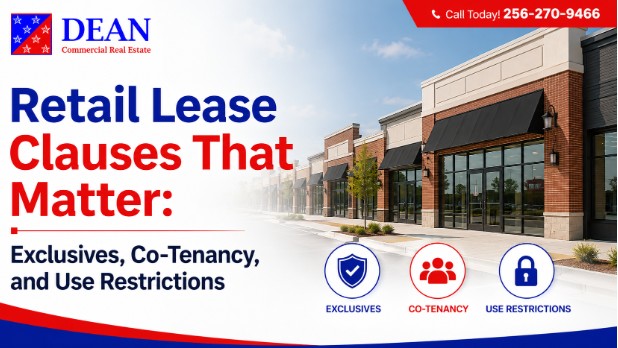
A co-tenancy clause ties a retail tenant’s rent obligation to occupancy conditions in the shopping center — such as an anchor staying open or a set percentage of the gross leasable area remaining leased.
When those conditions fail, the clause triggers rent reduction, alternative rent, or termination rights.
Retail tenants who skip tenant advisory support often sign co-tenancy language too vague to ever trigger, leaving full rent due in a half-empty center.
Dean Commercial Real Estate, a commercial real estate brokerage in Huntsville, Alabama, specializing in retail, office, and industrial leasing, can review your lease before you commit to terms.
A co-tenancy clause is a lease provision that conditions a retail tenant’s rent obligation on specific occupancy levels in the shopping center, rather than solely on the tenant’s own performance.
Opening co-tenancy applies before a tenant’s store opens, giving the tenant the right to delay opening — or delay rent — if named anchors or a minimum percentage of the center haven’t opened yet.
Ongoing co-tenancy applies after opening and activates if an anchor closes or vacancy in the center drops below an agreed-upon threshold during the lease term.
| Trigger Event | Typical Remedy | Duration |
| Named anchor tenant vacates or goes dark | Rent reduced to percentage-only or alternative rent | Until anchor is replaced or cure period expires |
| Occupancy falls below stated percentage (e.g., 70% of GLA) | Rent abatement proportional to vacancy | Ongoing, recalculated monthly or quarterly |
| Cure period expires without landlord fixing occupancy | Tenant termination right | One-time election, typically 30-90 day notice |
A retail tenant relying on foot traffic from a grocery or department store anchor carries real exposure if that anchor closes and the lease has no co-tenancy protection — sales can fall while full rent stays due.
A co-tenancy clause is enforced as written, so vague trigger language rarely holds up without a specific occupancy percentage and named anchors.
If you’re ready to get started, call us now!
An exclusive use clause bars the landlord from leasing other space in the center to a tenant’s direct competitor, while a radius restriction clause limits where the tenant itself may open a competing location nearby.
An exclusive use clause is a restrictive covenant — an agreement between parties concerning the use of real property that imposes a burden on the landowner, per Cornell Law School’s Legal Information Institute — that prevents the landlord from leasing other space in the same center to a tenant selling a similar product or service.
A coffee shop with an exclusive use clause blocks the landlord from leasing to a second coffee retailer anywhere in the property.
A radius restriction clause runs the opposite direction: it limits the tenant’s ability to open a competing location within a set distance of the leased premises, protecting the landlord’s sales-based rent from cannibalization by the tenant’s own second store.
Landlords negotiating commercial lease representation on their side routinely push for tighter-radius language while resisting broad exclusive-use grants to tenants.
Exclusive-use language is read narrowly when it is vague, so tenants should define the protected category precisely rather than relying on broad terms such as “specialty retail,” per Cornell’s Wex Legal Dictionary entry on restrictive covenants.
These three clauses together define what a tenant may sell, what it may never sell, and whether it must keep the doors open.
The permitted use clause defines the specific business activity allowed in the space. Retail tenants should negotiate broad permitted-use language, since a narrow definition may require landlord approval whenever the business adds a product line or adjusts its model.
The prohibited use clause lists activities the landlord won’t allow anywhere in the center, often tied to other tenants’ exclusive-use protections, environmental concerns, or the center’s image — no auto repair, no adult entertainment, no drive-through without separate approval.
A continuous operation clause requires the tenant to keep the store open and staffed during specified hours for the full term of the lease.
Landlords rely on this clause to preserve foot traffic for neighboring tenants and to protect percentage rent income; tenants should negotiate carve-outs for renovation periods, force majeure events, and slow seasonal months.
Retail rent rarely stops at the quoted base figure — four clauses working together determine the real occupancy cost.
The base rent clause sets the fixed starting rent, while the rent escalation clause defines how and when that number increases — a flat annual bump, a Consumer Price Index tie, or stepped increases built into the lease rate quote. Tenants should confirm whether escalations compound and whether any cap applies.
The CAM clause passes through a share of the landlord’s costs for maintaining shared areas — parking lots, landscaping, common lighting, snow removal.
Retail tenants should negotiate a CAM cap, an audit right, and clear exclusions for capital improvements that shouldn’t be billed as maintenance, so you can avoid open-ended increases to a cost that sits outside the base rent number.
A percentage rent clause requires the tenant to pay a percentage of gross sales above a negotiated breakpoint, in addition to base rent.
Percentage rent is common in retail property leasing and shopping-center deals, and it makes the definition of “gross sales”—what’s excluded, how often it’s reported—one of the most consequential negotiation points in the lease.
Struggling to compare a percentage lease offer against a straight NNN deal? See how NNN, modified gross, and full-service leases stack up before you counter. Talk to Dean Commercial Real Estate about your retail lease terms.
If you’re ready to get started, call us now!
Lease term, renewal option, and early termination clauses set how long a retail tenant is committed and how the tenant can exit early.
The lease term clause sets the initial commitment period, typically five to ten years for retail space, balancing landlord demand for stable income against tenant demand for flexibility as the business grows or contracts.
A renewal option clause gives the tenant the right to extend the lease at predetermined or market-based rates, protecting against being forced out — or hit with a steep increase — when the initial term ends.
An early termination clause, sometimes called a kick-out right, allows the tenant to terminate the lease early if a specific condition occurs, typically tied to sales falling below a set threshold or to a co-tenancy failure that isn’t independently cured.
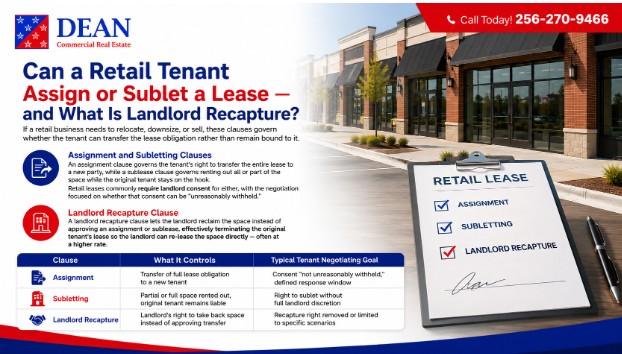
If a retail business needs to relocate, downsize, or sell, these clauses govern whether the tenant can transfer the lease obligation rather than remain bound to it.
An assignment clause governs the tenant’s right to transfer the entire lease to a new party, while a sublease clause governs renting out all or part of the space while the original tenant stays on the hook.
Retail leases commonly require landlord consent for either, with the negotiation focused on whether that consent can be “unreasonably withheld.”
A landlord recapture clause lets the landlord reclaim the space instead of approving an assignment or sublease, effectively terminating the original tenant’s lease so the landlord can re-lease the space directly — often at a higher rate.
| Clause | What It Controls | Typical Tenant Negotiating Goal |
| Assignment | Transfer of full lease obligation to a new tenant | Consent “not unreasonably withheld,” defined response window |
| Subletting | Partial or full space rented out, original tenant remains liable | Right to sublet without full landlord discretion |
| Landlord Recapture | Landlord’s right to take back space instead of approving transfer | Recapture right removed or limited to specific scenarios |
Insurance requirements and indemnification clauses determine who absorbs financial responsibility when something goes wrong on the premises.
The insurance requirements clause specifies the coverage types and minimum limits the tenant must carry — general liability, property, and sometimes business interruption — naming the landlord as an additional insured on the policy.
An indemnification clause requires one party to cover the other’s losses, claims, or legal costs arising from specific events, most often the tenant indemnifying the landlord for claims tied to the tenant’s use of the space. Before signing, a tenant should confirm the indemnification obligation is mutual where appropriate and doesn’t extend to the landlord’s own negligence.
Understanding key lease terms and how to evaluate a lease before signing are among the specific points the U.S. Small Business Administration highlights for business owners entering a commercial lease, underscoring why a full clause-by-clause review — not just a rent comparison — belongs in every retail lease decision.
What triggers a co-tenancy clause in a retail lease?
A co-tenancy clause typically triggers when a named anchor tenant closes, fails to open, or goes dark, or when total occupancy in the shopping center falls below an agreed percentage of gross leasable area. The specific trigger and remedy depend on the negotiated lease language.
Is a co-tenancy clause the same as an exclusive use clause?
No. A co-tenancy clause protects rent based on overall center occupancy, while an exclusive use clause blocks the landlord from leasing to a competing business. Retail tenants often negotiate both since they address different risks associated with the same shopping center.
Can a landlord refuse to grant an exclusive use clause?
Yes. In most cases, exclusive use clauses are fully negotiable, and landlords often resist granting them because they limit future leasing flexibility. Tenants with strong sales potential or anchor status typically have more leverage to secure exclusivity than smaller in-line tenants.
What happens if I violate a radius restriction clause?
Violating a radius restriction clause typically triggers a rent adjustment, such as switching the tenant to gross sales reporting that includes the nearby competing location, or a default remedy defined in the lease. The exact consequence depends on the specific language of the radius clause.
Do all retail leases include a continuous operation clause?
Not always, but continuous operation clauses are common in shopping centers where foot traffic supports neighboring tenants and percentage rent income. Standalone retail locations are generally less likely to include strict continuous-operation requirements than in-line spaces within a larger shopping center.
How is CAM different from percentage rent?
CAM charges reimburse the landlord for shared property costs, such as landscaping and parking lot maintenance, and are billed regardless of sales performance. Percentage rent is calculated as a share of the tenant’s gross sales above a breakpoint, tying part of the rent directly to store performance.
Can a tenant negotiate the landlord’s recapture right?
Yes. Tenants can often negotiate to remove recapture rights entirely, limit them to specific circumstances, or require the landlord to pay transaction costs if recapture is exercised. Negotiating recapture rights matters most for tenants anticipating a future sale or relocation.
What insurance does a retail tenant usually need to carry?
Most retail leases require general liability insurance with a set minimum limit, along with property insurance covering the tenant’s fixtures and inventory. The landlord is also typically named as an additional insured, and some leases add business interruption coverage requirements.
Why does the definition of gross sales matter in a percentage rent clause?
The gross sales definition determines what income counts toward the percentage rent calculation. Exclusions for returns, sales tax, or online orders fulfilled from the store can significantly change the amount owed, making this definition one of the most heavily negotiated points in the clause.
Should a retail tenant negotiate these clauses without a broker?
Retail lease clauses interact in ways that aren’t obvious from reading them individually — a weak co-tenancy clause can undercut a strong exclusive use clause, for example. These interactions are usually identified during a full lease review, before signing, rather than after a dispute arises.
If your current lease is missing co-tenancy or exclusive use protection, you may be carrying risk you never agreed to. Schedule a lease review with Dean Commercial Real Estate before your next renewal decision.