Call Today! 256-270-9466
Call Today! 256-270-9466
Originally published: September 2026
A commercial real estate broker’s commission is a percentage of a lease’s total base rent, and the landlord typically pays it and splits it with the tenant’s broker.
Alabama law requires written disclosure before a broker can represent both sides of the same deal, and federal antitrust guidance prohibits any fixed or standard commission rate.
Dean CRE’s tenant advisory team explains who pays, how splits work, and where conflicts can surface during a lease negotiation.
Every undisclosed conflict costs a tenant leverage in a lease negotiation. Dean CRE confirms commission terms at the LOI stage, before any client signs.
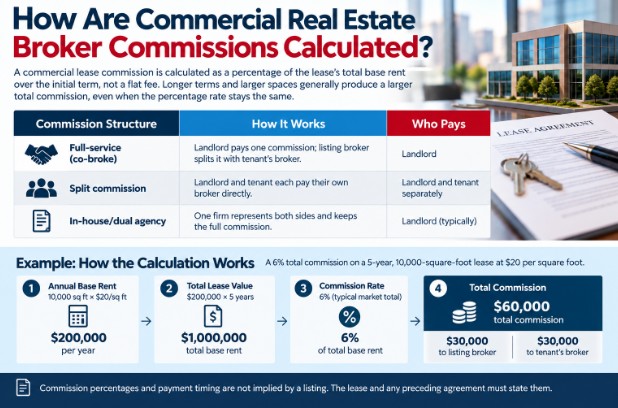
A commercial lease commission is calculated as a percentage of the lease’s total base rent over the initial term, not a flat fee. Longer terms and larger spaces generally produce a larger total commission, even when the percentage rate stays the same.
Dean CRE’s leasing and brokerage engagements follow this same percentage-based structure.
Dean CRE’s own tenant representation work shows commission splits totaling around 6% of the lease value in typical Huntsville deals. That total is divided between the listing broker and the tenant’s broker.
That split-commission model is the most common structure in the North Alabama market, and it means a tenant working with a broker rarely pays that broker a separate fee.
| Commission Structure | How It Works | Who Pays |
| Full-service (co-broke) | Landlord pays one commission; listing broker splits it with tenant’s broker | Landlord |
| Split commission | Landlord and tenant each pay their own broker directly | Landlord and tenant separately |
| In-house/dual agency | One firm represents both sides and keeps the full commission | Landlord (typically) |
Commission percentages and payment timing are not implied by a listing; the lease and any preceding agreement must state them.
A tenant should confirm both at the letter of intent stage, before the lease draft exists. That confirmation shapes how hard each broker is incentivized to work on the tenant’s behalf.
If you’re ready to get started, call us now!
The landlord pays the broker commission in most Huntsville commercial leases, and the tenant does not write a separate check to their own broker. The landlord builds the commission cost into the property’s overall leasing budget rather than billing it to the tenant as a line item.
The landlord funds the commission structure because it hires a listing broker to market the space and fill the vacancy.
That listing broker’s fee typically covers compensation for whichever broker brings the tenant.
Commission payment is commonly split into two installments: part at lease signing and part once the tenant takes occupancy. A tenant should ask whether their broker’s payment is tied to occupancy.
A broker paid only at signing has less financial stake in resolving delivery-condition disputes that arise before move-in, including those in vanilla shell vs. warm shell delivery terms.
When separate brokers represent the landlord and the tenant, they typically split the total commission evenly, though the exact split is negotiated per deal rather than fixed by any rule.
A 50/50 split is common in North Alabama, but landlords, listing agreements, and brokerage-to-brokerage agreements can set a different division.
A broker’s compensation also does not stop at the split with the other side’s broker. The listing broker and the tenant’s broker each typically share their half with their own brokerage firm under an in-house commission split.
The amount an individual broker takes home is often smaller than the headline commission percentage suggests.
Renewal and expansion transactions can pay commission again. A broker who negotiated renewal options and expansion rights into the original lease often earns a new commission when the tenant later exercises those rights.
Tenants should ask whether a broker’s fee already covers future renewals or resets with each new term, so they can budget for a possible second commission before signing.
Dual agency occurs when one brokerage firm represents both the landlord and the tenant in the same lease transaction.
It creates an inherent conflict because the firm owes loyalty duties to two parties negotiating against each other. Alabama law permits dual agency only with written informed consent from both sides.
Under Alabama Code § 34-27-81, a limited consensual dual agent is a licensee who represents both parties to a transaction with their written informed consent.
Dual agency also arises when two licensees under the same qualifying broker each represent different parties in the same deal.
Alabama Code § 34-27-82 requires every licensee to disclose their role as a single agent, dual agent, or transaction facilitator.
The Alabama Real Estate Commission writes the disclosure form used statewide for this purpose.
Once consent is given, a dual agent cannot advocate exclusively for either party’s economics. Negotiated outcomes in a dual-agency deal tend toward the middle, rather than toward either side’s best terms.
A tenant weighing a space where the listing broker is the only broker involved should ask directly whether that broker will act as a dual agent. Consenting to dual agency trades away one-sided advocacy for a single point of contact.
If you’re ready to get started, call us now!
Broker commission rates are fully negotiable, and no state or federal rule sets a standard percentage for a commercial lease. Federal antitrust law generally treats agreements among competing brokers to fix or standardize commission rates as anticompetitive.
In a 2005 comment letter, the FTC and Department of Justice urged the Alabama Senate to reject a bill that would have imposed minimum service requirements on real estate brokers.
The agencies argued that such mandates limit the flexible, negotiable brokerage arrangements that benefit consumers.
A tenant or landlord can negotiate a broker’s commission percentage the same way they negotiate any other contract term. A broker’s willingness to negotiate that rate is itself a signal worth weighing when comparing tenant representation options against a dual-agency alternative.
A properly qualified real estate agent is treated as self-employed for federal tax purposes, not as an employee of the brokerage that pays the commission. Self-employed tax status affects how the broker reports commission income and pays employment taxes.
The IRS classifies licensed real estate agents as one of three categories of statutory nonemployees.
They are treated as self-employed for all federal tax purposes when substantially all of their pay is tied to sales output rather than hours worked. This treatment also requires a written contract stating the agent will not be treated as an employee.
26 U.S.C. § 3508 codifies this treatment. The statute provides that a qualified real estate agent is not treated as an employee, and the brokerage paying the commission is not treated as the employer.
Federal tax classification is a separate question from a broker’s professional duties. A broker’s statutory nonemployee status under federal tax law does not change the fiduciary duties that broker owes a client under Alabama license law.
A landlord or tenant should not assume the two issues are related when evaluating a broker’s representation.
A tenant pays a broker directly in a small number of situations rather than the standard landlord-paid commission structure. Subleases and unrepresented landlord transactions are the two most common exceptions.
Comparing total occupancy cost the same way for both scenarios still matters, using the same lease rate quote conventions applied in a direct lease.
In a sublease, the party subleasing the space generally pays the broker. No listing landlord with a leasing budget exists to fund the commission the way a direct landlord lease does.
A tenant working through a step-by-step commercial leasing process that involves a sublease should confirm broker payment terms before touring space, not after selecting a favorite.
A tenant can also negotiate a retainer or flat fee with their broker for a highly specialized search.
This arrangement is more likely when the landlord side of a target deal has no commission budget built in, such as an owner-user sale-leaseback or an off-market negotiation.
A retainer or flat-fee arrangement is the exception, and a tenant should expect it to be stated explicitly in a signed brokerage agreement, not assumed.
Does the tenant pay their broker’s commission?
The tenant typically does not pay their broker’s commission directly. The landlord funds the full commission, which is usually split between the listing broker and the tenant’s broker, so tenant representation generally costs the tenant nothing out of pocket at signing.
What percentage commission do commercial brokers typically charge?
Commission percentages vary by deal and are fully negotiable rather than standardized. Huntsville-area tenant representation commonly totals around 6% of lease value before that total splits between the two brokers, though the exact rate depends on lease size, term, and negotiation.
Is dual agency legal in Alabama?
Dual agency is legal in Alabama with written informed consent from both parties. Alabama Code § 34-27-82 requires the broker to disclose their role as a single agent, dual agent, or transaction facilitator, using a disclosure form the Alabama Real Estate Commission writes.
Can a tenant negotiate their broker’s commission split?
A tenant can negotiate their broker’s commission percentage and split, since no state or federal rule fixes commission rates. Federal antitrust guidance generally treats agreements among competing brokers to standardize rates as anticompetitive, so tenants and landlords can negotiate the percentage.
When is broker commission paid during a lease?
Broker commission is commonly paid in two installments: part at lease signing and the remainder once the tenant takes occupancy. Payment timing varies by brokerage agreement and should be confirmed in writing before a tenant signs the lease or the listing agreement.
Do commercial brokers get paid again on a lease renewal?
A broker can earn a new commission when a tenant exercises a renewal or expansion option, depending on what the original brokerage agreement states. Tenants should ask whether the original commission already covers renewals or resets with each new term.
Are real estate brokers considered employees for tax purposes?
A properly qualified real estate agent is treated as self-employed, not as an employee, for federal tax purposes under 26 U.S.C. § 3508. This applies when substantially all of the agent’s pay ties to sales output under a written nonemployee contract.
What is the difference between a listing broker and a tenant’s broker?
A listing broker represents the landlord and markets the space to fill the vacancy on the landlord’s terms. A tenant’s broker represents the tenant exclusively and negotiates business-friendly terms on the tenant’s behalf, and the two brokers typically split the landlord-paid commission.
An undisclosed dual agency or an unclear commission split can cost a tenant real negotiating power. Call Dean CRE at (256) 270-9466 to confirm how your broker gets paid before you tour a space.