Call Today! 256-270-9466
Call Today! 256-270-9466
Originally published: August 2026
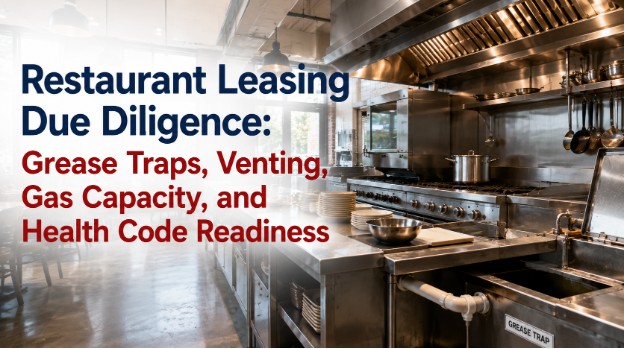
Restaurant leasing due diligence centers on four systems a standard retail buildout doesn’t need: grease trap capacity, kitchen exhaust venting, gas service capacity, and health department readiness.
Each is regulated by a different authority — the sewer department, the fire marshal, the gas utility, and the county health department — and none of their approvals automatically transfer from a property’s prior tenant to a new operator.
A restaurant tenant who confirms all four systems before signing an LOI avoids discovering an expensive shortfall once construction is already underway, when the cost of fixing it falls almost entirely on the tenant.
Grease trap sizing and hood requirements can turn a good location into an expensive buildout. Call Dean CRE at (256) 270-9466 before signing an LOI on restaurant space.
A restaurant lease requires confirming grease trap sizing, kitchen exhaust and makeup air, gas service capacity, and health department plan review — infrastructure a general retail tenant rarely touches.
Second-generation restaurant space often has a practical head start, but confirm each system individually, not by assumption.
| System | Second-Generation Space | Shell / Conversion |
| Grease trap/interceptor | Likely installed — confirm capacity vs. new concept’s volume | New installation + sewer authority approval required |
| Kitchen exhaust (hood/duct/fan) | May exist — confirm vs. current code and new equipment | Full hood/duct/makeup-air design required |
| Gas service | May be sufficient — confirm meter/line size with utility | Utility coordination, possible line upgrade |
| Health department approval | Doesn’t carry over — new plan review required | Full plan review from a blank layout |
Tenant representation at the site-selection stage matters most for this comparison, before a specific property is under LOI.
Grease trap sizing is regulated by the local sewer authority, separately from health department food-safety review — both can apply to the same kitchen.
In Huntsville, this falls under the city’s Fats-Oil-Grease (FOG) program, administered by Water Pollution Control’s Industrial Pretreatment Division.
Confirm the existing trap’s condition and remaining capacity before assuming it can handle a higher volume than the space’s prior tenant.
A restaurant tenant negotiating tenant improvement funds should confirm whether grease trap installation or upsizing sits in the landlord’s buildout scope or the tenant’s, since new interceptor installation is a high standalone cost.
If you’re ready to get started, call us now!
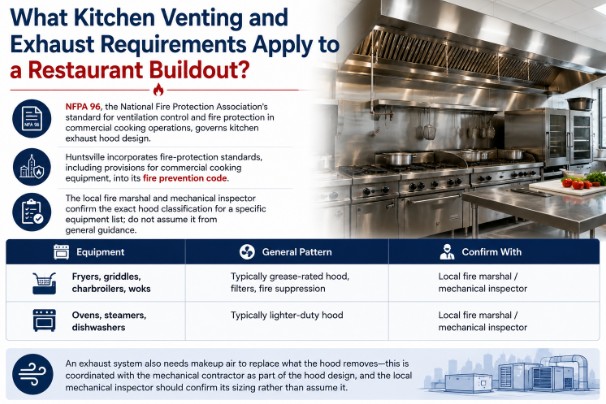
NFPA 96, the National Fire Protection Association’s standard for ventilation control and fire protection in commercial cooking operations, governs kitchen exhaust hood design.
Huntsville incorporates fire-protection standards, including provisions for commercial cooking equipment, into its fire prevention code.
The local fire marshal and mechanical inspector confirm the exact hood classification for a specific equipment list; do not assume it from general guidance.
| Equipment | General Pattern | Confirm With |
| Fryers, griddles, charbroilers, woks | Typically grease-rated hood, filters, fire suppression | Local fire marshal / mechanical inspector |
| Ovens, steamers, dishwashers | Typically lighter-duty hood | Local fire marshal / mechanical inspector |
An exhaust system also needs makeup air to replace what the hood removes—this is coordinated with the mechanical contractor as part of the hood design, and the local mechanical inspector should confirm its sizing rather than assume it.
This is easy to miss when reusing a hood sized for a previous tenant’s smaller cookline. Confirming who’s responsible for exhaust repairs in the lease document matters more here than for office tenants, since an exhaust failure can shut down service entirely.
Gas capacity depends on the existing meter and line size, which you should confirm with the local gas utility before assuming the existing infrastructure supports a new equipment load.
Replacing a previous tenant’s equipment with a higher-volume cookline — more burners, a larger griddle, added fryers — can exceed what the existing line was sized for, even in a second-generation space. Confirming this during the LOI stage avoids a costly mid-buildout line upgrade.
In Dean CRE’s experience, grease, venting, and gas gaps rarely surface during a walkthrough — they tend to show up once a contractor opens the walls.
Dean CRE’s tenant advisory team reviews restaurant LOIs for lease-negotiation and buildout-responsibility terms before signing.
If you’re ready to get started, call us now!
Health department plan review for Alabama food service establishments is administered locally — in Huntsville and Madison County, by Madison County Environmental Services under ADPH.
Plans for new construction, remodeling, or conversion generally require review and approval before construction begins.
A prior operator’s approval typically doesn’t carry over automatically — confirm directly with the local health office for the specific property.
Confirm, before signing, who’s responsible for grease trap installation or upsizing, exhaust system installation or upgrade, gas line upgrades, and any health-department-required layout changes.
These terms are generally more negotiable at the letter of intent stage than after a lease is drafted.
A triple-net, modified gross, or full-service structure also determines who absorbs recurring costs — hood cleaning, grease trap pumping, gas line maintenance — and these should be addressed explicitly rather than assumed.
A restaurant LOI should specify grease trap adequacy or upgrade responsibility, hood/exhaust adequacy or upgrade responsibility, confirmed gas capacity, and a health department plan-review timeline relative to construction.
Backing these terms with documentation — a written gas-capacity confirmation from the utility, a contractor’s hood assessment, or the health department’s plan-review checklist — gives both sides something concrete to negotiate against.
Restaurant leasing due diligence comes down to confirming grease, exhaust, gas, and health-review readiness before signing — each regulated by a different authority, and a prior operator’s approvals don’t automatically apply to a new tenant. Confirming responsibility for each system at the LOI stage is far cheaper than discovering a gap mid-construction.
Grease trap sizing, hood requirements, and gas capacity are easiest to resolve before signing. Call Dean CRE at (256) 270-9466 for a lease review.
Does a grease trap stay with the property when a new restaurant moves in?
An existing grease trap typically stays with the property, but confirm its condition and remaining capacity before assuming it fits. A higher-volume concept than the previous tenant can exceed what the trap was sized for, requiring an upgrade before opening.
Who do I contact about grease trap requirements in Huntsville?
Grease trap and interceptor requirements in Huntsville fall under the city’s Fats-Oil-Grease program, run by Water Pollution Control’s Industrial Pretreatment Division. This is separate from health department food-safety review, and both can apply to the same kitchen.
Do I need a Type 1 hood for a commercial kitchen?
Equipment producing grease-laden vapor — fryers, griddles, charbroilers — typically needs a grease-rated hood with filters and fire suppression under NFPA 96, incorporated into Huntsville’s fire code. Confirm the exact classification with the local fire marshal.
Can I reuse an existing hood system for a new restaurant concept?
An existing hood may be reusable, but a mechanical contractor should check its sizing against the new concept’s equipment and cooking volume. A hood sized for a smaller cookline may not meet current requirements for higher-volume equipment.
How do I check if a restaurant space has enough gas for my equipment?
Contact the local gas utility to confirm the existing meter and line size before assuming existing infrastructure supports your equipment load. This matters most when replacing a previous tenant’s equipment with a higher-volume cookline.
Does a restaurant health permit transfer to a new owner?
Typically not automatically. A new operator taking over an existing restaurant space should confirm directly with Madison County Environmental Services whether a new plan review and permit are required for the change in operator.
How long does health department approval take for a restaurant buildout?
Timelines vary by scope and current review volume. Plans generally need submission and approval before construction begins — confirm the current expected timeline directly with Madison County Environmental Services when submitting.
What should I ask for in a restaurant LOI?
Confirm grease trap adequacy or upgrade responsibility, hood/exhaust adequacy or upgrade responsibility, confirmed gas capacity, and a health department plan-review timeline relative to the construction schedule.
Who pays for grease trap or hood upgrades — landlord or tenant?
Responsibility varies by lease and is one of the most negotiable items at the LOI stage. Confirming it in writing before the lease is drafted helps prevent a dispute over an expensive system once the buildout is underway.
Is a former restaurant space always cheaper to build out than a shell?
Often, since grease trap, venting, and gas infrastructure may already exist, but it’s not guaranteed. Confirm each system individually against the new concept’s requirements before assuming a cost advantage.