Call Today! 256-270-9466
Call Today! 256-270-9466
Originally published: June 2026
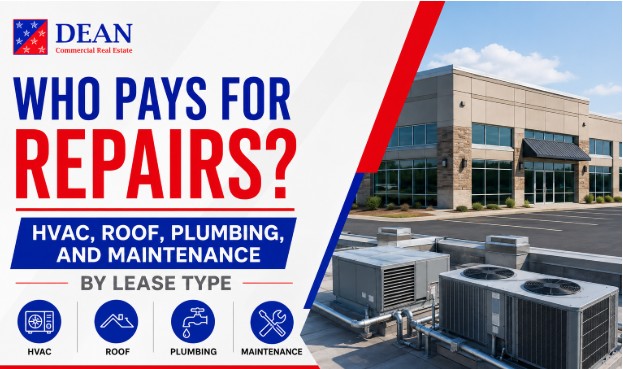
Lease type determines repair responsibility in an Alabama commercial lease — not default law. In a triple-net lease, the tenant pays for most repairs, including HVAC, plumbing, and roof maintenance; in a full-service gross lease, the landlord covers nearly all operating costs.
Most disputes over commercial repairs in Huntsville and Madison County arise not from ambiguous law but from lease language that tenants did not read closely before signing.
Repair obligations buried in lease language cost Huntsville tenants thousands of dollars in unexpected maintenance bills every year. Dean CRE’s tenant advisory services review repair and maintenance clauses before you sign — so the cost allocation is clear before you take occupancy.
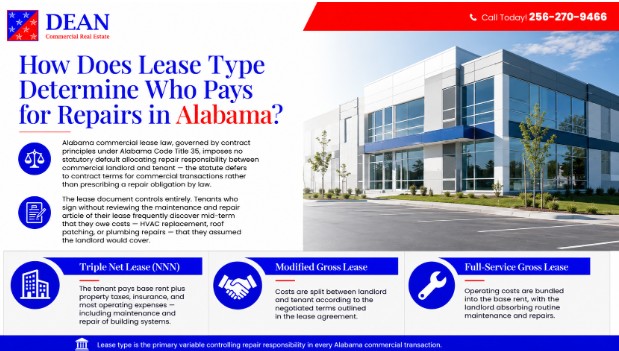
Lease type is the primary variable controlling repair responsibility in every Alabama commercial transaction. A triple net lease (NNN) requires the tenant to pay base rent plus property taxes, insurance, and most operating expenses — including maintenance and repair of building systems.
A modified gross lease splits those costs between landlord and tenant according to negotiated terms. A full-service gross lease bundles operating costs into the base rent, with the landlord absorbing routine maintenance.
Alabama commercial lease law, governed by contract principles under Alabama Code Title 35, imposes no statutory default allocating repair responsibility between commercial landlord and tenant — the statute defers to contract terms for commercial transactions rather than prescribing a repair obligation by law.
The lease document controls entirely. Tenants who sign without reviewing the maintenance and repair article of their lease frequently discover mid-term that they owe costs — HVAC replacement, roof patching, or plumbing repairs — that they assumed the landlord would cover.
Commercial repair disputes in Huntsville and Madison County arise from 3 sources: vague language about who maintains the HVAC system, silence on roof repair responsibility beyond normal wear, and disagreement over whether a plumbing failure qualifies as a capital repair (landlord) or routine maintenance (tenant).
Understanding the types of commercial leases in Alabama before entering any negotiation is the first step toward avoiding these disputes.
The maintenance and repair article of a commercial lease typically assigns responsibility across 4 categories worth mapping: (1) structural and exterior components, (2) building systems (HVAC, electrical, plumbing), (3) interior finishes and fixtures, and (4) common areas.
Each category may carry a different cost allocation depending on the lease type. Tenants should map every repair category to a named party before executing any lease in Huntsville’s commercial market.
HVAC responsibility is the single most frequently disputed repair obligation in North Alabama commercial leases.
In a triple-net lease, the tenant typically pays for all HVAC maintenance and repairs — and in many NNN leases, the tenant bears the cost of a full HVAC unit replacement if the system fails during the lease term.
In a modified gross lease, responsibility depends on the negotiated terms: some assign HVAC maintenance to the tenant and replacement to the landlord; others split costs based on a defined dollar threshold.
In a full-service gross lease, the landlord covers HVAC maintenance and replacement as part of the bundled operating cost.
A standard HVAC replacement for a 3,000-square-foot commercial space in Huntsville, Alabama, ran between $8,000 and $15,000 in 2025, according to RS Means commercial cost data.
A tenant who signed an NNN lease without negotiating an HVAC capital replacement cap absorbs the full cost — a budget exposure most small-business tenants do not anticipate at lease signing.
Most commercial leases distinguish between HVAC maintenance (filter changes, seasonal servicing, minor repairs) and HVAC replacement (a full unit swap when the system reaches the end of its life).
NNN leases frequently assign both to the tenant. Modified gross leases often assign maintenance to the tenant and replacement to the landlord — but only if the lease explicitly draws that distinction.
Tenants negotiating a commercial lease LOI should request an express maintenance-versus-replacement distinction in the HVAC clause and a dollar threshold above which the landlord assumes the repair cost.
Tenants signing leases on older Huntsville commercial buildings — particularly industrial and flex properties along Research Park Boulevard and the I-565 corridor — should request an HVAC condition disclosure before execution and negotiate an age cap clause.
An age cap clause transfers responsibility for replacing any HVAC unit older than a defined age (typically 10 years) to the landlord, regardless of lease type.
Dean CRE’s tenant representation team routinely negotiates age-cap protections for Huntsville tenants signing NNN leases for second-generation commercial space.
If you’re ready to get started, call us now!
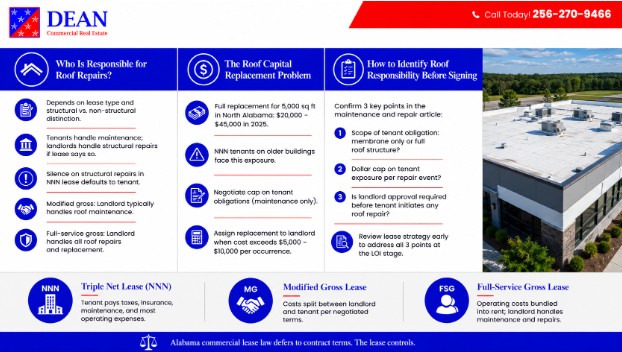
Roof repair responsibility depends on the lease type and includes a structural/non-structural distinction that most tenants overlook. In a triple-net lease, the tenant typically pays for roof maintenance—sealing, patching, and routine upkeep of the roof membrane.
Structural roof repairs, meaning repairs to the roof deck, joists, or building envelope caused by age or defect rather than tenant action, are more commonly assigned to the landlord even in NNN leases — but only if the lease says so explicitly.
Silence regarding structural roof repairs in an NNN lease defaults to the tenant’s responsibility under Alabama contract principles.
In a modified gross lease, roof maintenance is typically the landlord’s responsibility, and most professionally negotiated modified gross leases in Madison County expressly exclude roof and structural components from tenant obligations.
Full-service gross leases assign all roof repair and replacement to the landlord as part of the operating expense bundle.
A full roof replacement for a 5,000-square-foot commercial building in North Alabama costs $20,000 to $45,000 in 2025, depending on materials and pitch.
NNN tenants who have not negotiated a roof replacement carve-out face this exposure on older buildings.
The standard negotiating position for tenants is to cap NNN roof obligations at maintenance and patching — and assign replacement of the roof structure and membrane to the landlord when replacement cost exceeds a defined dollar threshold, typically $5,000 to $10,000 per occurrence.
Tenants reviewing a commercial lease should locate the maintenance and repair article and confirm 3 things about roof obligations worth verifying:
(1) whether the tenant’s obligation covers the membrane only or the full roof structure,
(2) whether a dollar cap limits the tenant’s exposure per repair event
(3) whether landlord approval is required before the tenant initiates any roof repair.
Reviewing the lease negotiation strategy before execution gives tenants a framework to address all 3 points at the LOI stage.
An unexpected repair obligation can turn a profitable lease into an operating loss within 12 months. Dean CRE’s commercial lease representation team negotiates maintenance and repair clauses in Huntsville and Madison County transactions so tenants understand every dollar of exposure before occupancy begins.
Plumbing responsibility in Alabama commercial leases follows the interior-versus-exterior distinction. Interior plumbing — pipes, fixtures, and drains within the leased premises — is typically the tenant’s responsibility in NNN and modified gross leases.
Exterior plumbing, meaning the building’s main lines, sewer connections, and underground infrastructure, is more commonly assigned to the landlord across all lease types.
Full-service gross leases assign all plumbing repair to the landlord as part of the operating cost bundle.
Structural repairs — foundation, load-bearing walls, and building envelope — are almost universally assigned to the landlord in Alabama commercial leases, regardless of lease type.
A landlord who refuses to make structural repairs that render the premises unsafe or unusable may face a claim of constructive eviction under Alabama contract law.
Tenants whose landlords delay structural repairs should document the condition in writing and consult the property management obligations that govern their building before taking action.
Electrical repair responsibilities mirror the plumbing structure: interior electrical systems serving the leased premises are typically the tenant’s obligation under NNN leases, while the building’s main service panel, exterior wiring, and shared electrical infrastructure remain the landlord’s responsibility.
Modified gross leases vary — some assign all electrical to the landlord, others split by location (panel versus premises). Full-service gross leases include all electrical in the landlord’s operating cost obligation.
The capital-versus-maintenance distinction governs cost allocation in every lease type. Routine maintenance — replacing light fixtures, clearing drains, patching drywall — is nearly always the tenant’s obligation regardless of lease structure.
Capital repairs — replacing a roof, upgrading electrical service, repairing a foundation — are typically the landlord’s responsibility under modified gross and full-service leases and are negotiable under NNN leases.
Tenants reviewing property management FAQs for their building type can identify which repair categories their landlord has historically treated as capital versus maintenance.
If you’re ready to get started, call us now!
A triple-net tenant in Alabama owes base rent plus 3 categories of operating expenses: property taxes, building insurance, and maintenance and repair of the leased premises and its systems.
In practice, a NNN tenant’s maintenance obligation in a North Alabama commercial lease encompasses HVAC servicing and repair, interior plumbing and electrical maintenance, pest control, parking lot upkeep where the tenant has exclusive use, and janitorial services.
The breadth of NNN maintenance exposure is why tenant advisors consistently recommend negotiating repair caps and carve-outs at the LOI stage.
Understanding how CAM charges interact with NNN maintenance obligations is essential for tenants in multi-tenant buildings. CAM charges cover shared area maintenance — parking lots, lobbies, landscaping — while NNN maintenance obligations cover the tenant’s exclusive space and systems.
Tenants who confuse CAM and NNN obligations frequently underfund maintenance reserves and face end-of-lease restoration demands from landlords.
NNN maintenance caps are not standard in NNN leases; tenants must negotiate them. A NNN maintenance cap limits the tenant’s annual out-of-pocket repair exposure to a defined dollar amount — anything above the cap becomes the landlord’s responsibility.
Cap structures in Huntsville’s commercial market typically set tenant maintenance liability at a per-square-foot annual amount, with the landlord responsible for costs above that threshold.
Tenants exploring how to lease commercial space in North Alabama should treat a maintenance cap as a non-negotiable agenda item in any NNN negotiation.
A modified gross lease allocates maintenance costs through a negotiated split that varies by property and landlord.
The most common structure in Madison County’s office and flex market assigns HVAC maintenance, interior repairs, and janitorial services to the tenant. At the same time, the landlord covers roof, structure, exterior, and common-area maintenance.
Tenants reviewing retail property leasing options in Huntsville should confirm whether the lease is a true modified gross or an NNN with selective landlord carve-outs — the distinction determines thousands of dollars in annual maintenance exposure.
Repair and maintenance obligations should be negotiated at the letter of intent stage — not during lease redlines when landlord leverage is highest. Tenants in Huntsville’s commercial market should address 4 repair issues worth covering in every LOI:
Dean CRE’s leasing and brokerage team in Huntsville structures repair and maintenance protections into LOI language before the lease draft stage — so tenants do not negotiate these points against a completed document.
Tenants who engage a tenant advisor before the LOI consistently secure better maintenance terms than those who rely solely on lease redlines.
Before executing any Alabama commercial lease, a tenant should confirm the 5 clauses worth reviewing in the maintenance and repair article:
Reviewing effective leasing strategies for the North Alabama market before entering negotiations gives tenants a checklist framework for every repair clause.
Who pays for HVAC repairs in a triple net lease in Alabama?
The tenant pays for HVAC maintenance and repair under a triple-net lease in Alabama, including full unit replacement unless the lease includes an age cap or a dollar threshold that shifts replacement costs to the landlord. Tenants should negotiate this distinction explicitly at the LOI stage before any NNN lease is executed.
Does Alabama law say who is responsible for commercial building repairs?
Alabama imposes no statutory default allocating repair responsibility between commercial landlords and tenants. Alabama Code Title 35 governs property law but defers to contract terms for commercial transactions. The lease document controls repair obligations entirely, making pre-execution review the only reliable protection for Alabama commercial tenants.
What is a NNN maintenance cap, and do I need one in Huntsville?
An NNN maintenance cap limits a tenant’s annual out-of-pocket repair obligation to a defined per-square-foot amount, with the landlord absorbing any costs above that threshold. Cap structures vary by property and negotiation. Any tenant signing a NNN lease on second-generation commercial space in Huntsville should negotiate one before execution.
Who pays for roof replacement in a commercial lease in Alabama?
Lease type controls roof replacement responsibility in Alabama. NNN tenants typically bear roof replacement costs unless a carve-out assigns structural replacement to the landlord. Modified gross and full-service gross leases assign roof replacement to the landlord in most professionally drafted Alabama commercial leases. Tenants should confirm the scope in writing.
Is the landlord responsible for plumbing repairs in a commercial lease?
Landlords are typically responsible for exterior and main-line plumbing in Alabama commercial leases, regardless of lease type. Interior plumbing within the leased premises is the tenant’s obligation in NNN and modified gross leases. Full-service gross leases assign all plumbing repair to the landlord as part of the operating cost bundle.
What repairs is a commercial landlord always responsible for in Alabama?
Structural repairs — foundation, load-bearing walls, and building envelope — are assigned to the landlord in nearly all Alabama commercial leases regardless of lease type. Exterior main-line plumbing and the building’s primary electrical service are also typically landlord obligations. A landlord who refuses to make structural repairs that create unsafe conditions may face a constructive eviction claim under Alabama law.
Can a tenant negotiate repair obligations in a Huntsville commercial lease?
Yes. Repair and maintenance obligations are negotiable in every Alabama commercial lease, and the most effective window is the letter of intent stage before the lease is drafted. Tenants can negotiate HVAC age caps, roof replacement carve-outs, NNN maintenance caps, and capital repair definitions — all of which reduce maintenance exposure over a 5- to 10-year term.
What is the difference between CAM charges and NNN maintenance obligations?
CAM charges cover shared area costs — parking lots, lobbies, and landscaping — allocated across all tenants in a multi-tenant building. NNN maintenance obligations cover the tenant’s exclusive space and building systems. Tenants who conflate CAM and NNN obligations frequently underfund maintenance reserves and face unexpected end-of-lease restoration demands.
Repair exposure you didn’t budget for starts with lease language you didn’t catch before signing. Dean CRE’s tenant advisory team negotiates maintenance caps, HVAC age protections, and roof carve-outs into every Huntsville lease — before you’re locked in.