Call Today! 256-270-9466
Call Today! 256-270-9466
Originally published: June 2026

A sublease transfers a portion of your lease rights to a third party while you remain liable to the landlord; an assignment transfers the entire lease — including all obligations — to a new tenant.
Alabama commercial leases govern both transactions through contract language, not statute, which means the lease you signed controls what you can and cannot do.
Most commercial leases in Alabama require written landlord consent before either transfer is permitted.
A sublease dispute or an unauthorized assignment can unravel years of business investment. Dean CRE’s tenant advisory services help Huntsville-area tenants review transfer clauses before they sign — not after a dispute starts.
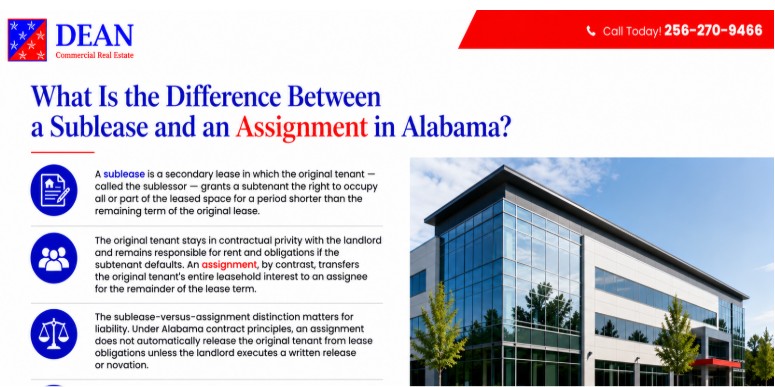
A sublease is a secondary lease in which the original tenant — called the sublessor — grants a subtenant the right to occupy all or part of the leased space for a period shorter than the remaining term of the original lease.
The original tenant stays in contractual privity with the landlord and remains responsible for rent and obligations if the subtenant defaults. An assignment, by contrast, transfers the original tenant’s entire leasehold interest to an assignee for the remainder of the lease term.
The sublease-versus-assignment distinction matters for liability. Under Alabama contract principles, an assignment does not automatically release the original tenant from lease obligations unless the landlord executes a written release or novation.
Many Huntsville commercial landlords require the original tenant to remain as guarantor even after a full assignment, particularly in multi-year office and retail leases.
Alabama courts apply traditional common law privity rules to commercial lease transfers. In a sublease, privity of contract exists between the original tenant and the subtenant, and separately between the original tenant and the landlord — but no direct privity exists between the subtenant and the landlord.
In an assignment, privity of estate shifts to the assignee, exposing the assignee to direct landlord claims for unpaid rent and lease violations.
When a tenant has negotiated a tenant improvement allowance from the landlord, the right to that allowance — or to any unamortized portion of it — typically does not transfer automatically to an assignee or subtenant.
The lease must expressly address what happens to TIA balances upon transfer; most Huntsville commercial leases are silent on this point, creating a negotiation gap.
If you’re ready to get started, call us now!
Alabama law does not impose a statutory consent requirement on commercial lease transfers, as some states do for residential tenancies. Commercial lease transfers in Alabama in 2026 are governed entirely by the lease agreement itself — Alabama property law under Title 35 defers to contract terms for commercial transactions rather than prescribing a consent mechanism by statute.
If your lease contains a “no assignment or subletting without landlord consent” clause, that clause is enforceable as written.
The practical consequence is that silence in a lease creates a default rule favoring the tenant. If a commercial lease contains no restriction on transfer, Alabama common law permits the tenant to sublease or assign freely.
However, very few professionally drafted commercial leases in North Alabama omit transfer restrictions — making the consent clause the operative standard in nearly all transactions.
Some Alabama commercial leases condition consent on the landlord not “unreasonably withholding” approval. This language imposes a good-faith obligation on the landlord but does not guarantee approval.
Alabama courts evaluate reasonableness based on the proposed subtenant’s financial strength, intended use, and compatibility with other tenants in multi-tenant properties. A landlord who refuses consent without documented financial or operational grounds risks a breach-of-contract claim by the tenant.
Many Huntsville commercial leases include a recapture clause that grants the landlord the right to terminate the lease and take the space back when a tenant requests assignment or sublease consent.
Tenants who trigger a consent request without understanding the recapture provision can inadvertently hand the landlord grounds to cancel a below-market lease. Reviewing the lease negotiation strategy before requesting consent is essential.
A subtenant in Alabama holds only the rights the sublessor transfers — and no more. Because the sublease is a derivative interest, any restriction in the master lease that limits use, hours of operation, signage, or parking access automatically flows down to the subtenant, even if the sublease does not restate those restrictions.
Subtenants who fail to review the master lease before signing frequently discover mid-occupancy that their intended use violates the primary lease’s permitted-use clause.
The subtenant also carries a vulnerability that direct tenants do not: if the original tenant (sublessor) defaults on the master lease and the landlord terminates the master lease, the subtenant’s occupancy rights terminate with it — regardless of whether the subtenant is current on sublease rent payments.
Some sophisticated subtenants negotiate a non-disturbance agreement directly with the landlord to protect against this outcome.
A lease transfer that looks straightforward can expose a business to liability it did not budget for. Dean CRE’s commercial lease representation team reviews sublease and assignment clauses in Huntsville and Madison County transactions before tenants commit.
An unauthorized sublease or assignment constitutes a material breach of the lease under Alabama contract law. The landlord’s remedies on breach include 3 primary options:
(1) terminate the lease and recover possession of the premises,
(2) affirm the lease and sue for damages
(3) accept the unauthorized transfer and treat it as a waiver of the consent requirement going forward.
Landlords who accept rent from an unauthorized subtenant without objection risk inadvertently waiving the breach.
Tenants facing an unauthorized transfer dispute benefit from an early review of documentation. Dean CRE’s tenant representation services include lease audit support that identifies how transfer violations are typically resolved in the Huntsville commercial market without litigation.
Alabama allows a commercial landlord to recover the difference between the contract rent and the fair market rental value of the premises for the remainder of the lease term if the lease is terminated following an unauthorized transfer.
The landlord also recovers attorney fees if the lease contains a prevailing-party fee clause — a standard provision in most professionally drafted North Alabama commercial leases.
Tenants who are assigned to a weaker credit tenant without consent may also face personal guaranty calls if the assignee subsequently defaults.
Common area maintenance charges under a CAM structure continue to accrue against the original tenant after an unauthorized assignment. Unless the lease expressly shifts CAM liability to the assignee and the landlord consents in writing to that shift, the original tenant remains jointly liable for annual CAM reconciliation charges, property tax pass-throughs, and insurance escalations for the full remaining term.
The time to negotiate transfer rights is during initial lease execution — not after a business transition forces the issue. Tenants in Huntsville’s commercial market, particularly those signing 5- to 10-year leases in industrial and retail corridors, should request 4 protections worth negotiating:
(1) a “no unreasonable withholding” consent standard,
(2) an express waiver of recapture rights on assignment to a qualified buyer,
(3) a release-of-guaranty provision triggered when the assignee demonstrates 12 months of financial performance
(4) an explicit non-disturbance clause for any permitted sublease.
Understanding the types of commercial leases in Alabama — NNN, modified gross, and full-service — is foundational before negotiating transfer provisions, because each lease structure allocates operating cost liability differently upon transfer.
Most institutional landlords in Madison County and the greater Huntsville commercial market will accept an affiliate transfer exemption — a provision allowing assignment to a parent, subsidiary, or successor entity without landlord consent.
This exemption is critical for tenants who anticipate corporate restructuring, private equity transactions, or changes to franchise systems during the lease term.
The exemption should define “affiliate” by ownership percentage threshold — typically 50% or greater common ownership — and require written notice to the landlord within 30 days of the transfer.
The commercial lease LOI stage is the most effective point at which to establish transfer rights, as landlords have the strongest incentive to accommodate tenant requests before the lease is drafted.
Tenants should include a transfer rights summary in the LOI that specifies consent standard, recapture waiver, and affiliate exemption terms.
LOI language on transfer rights that is omitted at this stage is frequently absent from the final lease and is difficult to reopen in negotiations.
If you’re ready to get started, call us now!
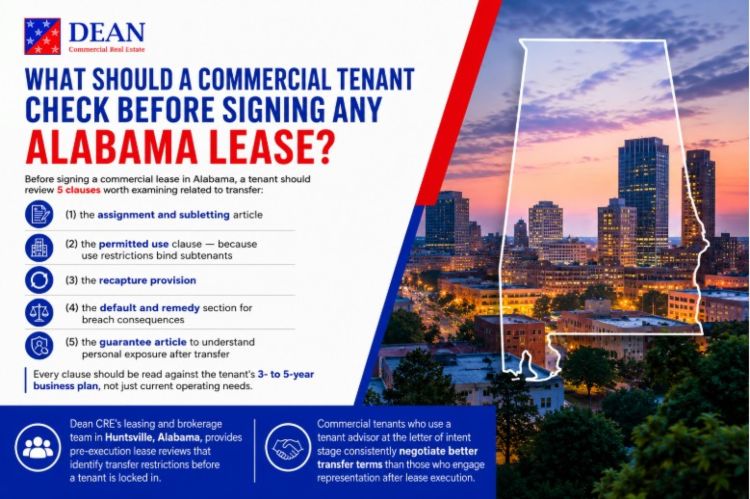
Before signing a commercial lease in Alabama, a tenant should review 5 clauses worth examining related to transfer:
(1) the assignment and subletting article,
(2) the permitted use clause — because use restrictions bind subtenants,
(3) the recapture provision,
(4) the default and remedy section for breach consequences
(5) the guarantee article to understand personal exposure after transfer. Every clause should be read against the tenant’s 3- to 5-year business plan, not just current operating needs.
Dean CRE’s leasing and brokerage team in Huntsville, Alabama, provides pre-execution lease reviews that identify transfer restrictions before a tenant is locked in.
Commercial tenants who use a tenant advisor at the letter of intent stage consistently negotiate better transfer terms than those who engage representation after lease execution.
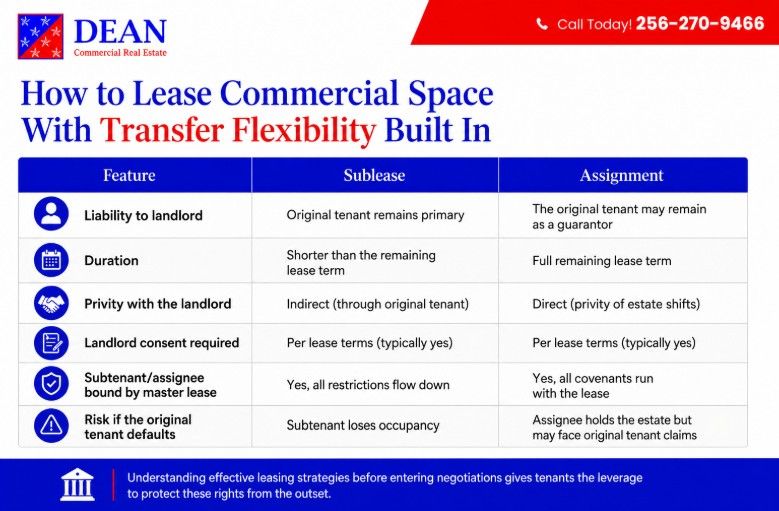
Tenants looking at how to lease commercial space in North Alabama should treat transfer rights as a non-negotiable agenda item in every negotiation.
A 5-year office lease without an affiliate exemption or a reasonable consent standard can become a business liability the moment ownership changes, a key employee departs, or a merger requires consolidation.
Understanding effective leasing strategies before entering negotiations gives tenants the leverage to protect these rights from the outset.
| Feature | Sublease | Assignment |
| Liability to landlord | Original tenant remains primary | The original tenant may remain as a guarantor |
| Duration | Shorter than the remaining lease term | Full remaining lease term |
| Privity with the landlord | Indirect (through original tenant) | Direct (privity of estate shifts) |
| Landlord consent required | Per lease terms (typically yes) | Per lease terms (typically yes) |
| Subtenant/assignee bound by master lease | Yes, all restrictions flow down | Yes, all covenants run with the lease |
| Risk if the original tenant defaults | Subtenant loses occupancy | Assignee holds the estate but may face original tenant claims |
Losing a below-market lease to an unauthorized transfer is one of the costliest mistakes Huntsville tenants make. Dean CRE’s tenant advisory team reviews every transfer clause before you sign — protecting the occupancy rights your business depends on.
Can a commercial tenant in Alabama sublease without telling the landlord?
Only if the lease contains no transfer restriction, which is rare in professionally drafted Alabama commercial leases. Most North Alabama commercial leases contain explicit written consent requirements. Proceeding without notice when the lease requires it constitutes a material breach and exposes the tenant to termination and damages under Alabama contract law.
Does Alabama have a law that limits what landlords can charge for sublease consent?
Alabama imposes no statutory cap on fees a landlord may charge for granting sublease or assignment consent in a commercial lease. The lease governs fee terms entirely. Tenants should negotiate a consent fee cap — typically a flat dollar amount or attorneys’ fees reimbursement only — during initial lease execution or at the LOI stage.
What is the difference between a sublease and an assignment in plain terms?
In a sublease, the original tenant rents the space to another party while remaining on the hook to the landlord. An assignment hands off the full lease to a new tenant for the remaining term. The original tenant stays primarily liable in a sublease and may remain as guarantor in an assignment under Alabama contract principles.
Can a landlord in Alabama refuse to consent to an assignment for any reason?
Yes, if the lease grants the landlord absolute discretion over consent. Where the lease requires consent not to be unreasonably withheld, refusal must rest on objective criteria — the proposed assignee’s financial strength, intended use, or tenant compatibility. A landlord who refuses on arbitrary grounds risks a breach-of-contract claim under Alabama law.
What happens to the security deposit when a commercial lease is assigned in Alabama?
Security deposit disposition depends entirely on the lease and any assignment agreement the landlord executes. Absent an express transfer of deposit rights, the landlord typically retains the original deposit against the original tenant’s obligations. A well-drafted assignment agreement addresses deposit transfer, credit adjustment, and replacement deposit requirements.
Does a subtenant have to pay CAM charges in Alabama?
A subtenant pays CAM charges only if the sublease agreement requires it. The original tenant remains liable to the landlord for all CAM obligations under the master lease, regardless of sublease terms. Subtenants who do not reimburse the original tenant for CAM create a funding gap — a common oversight in informal sublease arrangements in Huntsville’s commercial market.
Can a landlord terminate a commercial lease if the tenant’s business is sold in Alabama?
A business sale that includes a lease assignment triggers the lease’s transfer provisions. A landlord may terminate if the tenant assigns without required consent, or may elect recapture rather than approve the transfer if a recapture clause exists. Business sellers in Alabama must review lease transfer rights before closing any asset sale.
What is a non-disturbance agreement, and does a subtenant need one in Alabama?
A non-disturbance agreement protects a subtenant’s occupancy rights if the master lease terminates. Alabama law does not require landlords to offer them, so subtenants must negotiate directly. Any subtenant occupying commercial space in Madison County or Huntsville for more than 12 months should secure this protection in writing before taking occupancy.