Call Today! 256-270-9466
Call Today! 256-270-9466
Originally published: May 2026
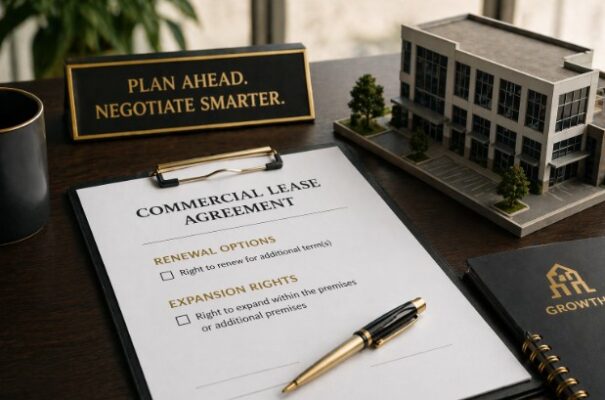
Commercial tenants in Alabama lose renewal rights, pay above-market rent at expiration, and forfeit expansion priority every year — not because those protections are unavailable, but because no one requested them before the lease was signed.
A renewal option is a contractual clause that locks in a tenant’s right to extend occupancy at defined terms. An expansion right is a contractual provision that secures priority access to adjacent space before the landlord markets that space to a third party.
Both clauses must be negotiated before lease execution; landlords do not volunteer either protection without a direct tenant request.
A renewal option is a contractual clause that gives a commercial tenant the right — but not the obligation — to extend the lease for a defined additional term at predetermined or formula-based rent.
Alabama commercial leases do not include renewal options by default; a tenant who does not negotiate a renewal option before signing receives no contractual right to remain in the space at expiration.
A renewal and a lease extension are two legally distinct instruments. A lease extension continues the existing lease under its original terms — every protection already negotiated, including expansion rights, rent caps, and assignment provisions, survives through the extended term.
A lease renewal creates a new document at expiration; clauses personal to the original parties do not automatically carry over unless the tenant’s attorney expressly includes them.
Tenants negotiating commercial leases in Alabama should request extension language wherever the landlord will accept it, so you can preserve every negotiated protection through the full extended occupancy period.
| Term | Definition | Key Tenant Risk |
| Renewal Option | Contractual right to extend at the tenant’s election | Forfeited if the notice deadline is missed |
| Lease Extension | Continuation of existing lease under original terms | All negotiated protections survive |
| Lease Renewal | New lease document executed at expiration | Original protections lapse unless re-included |
| Holdover Tenancy | Occupancy continues after expiration without a signed agreement | The landlord may charge 150–200% of the base rent or initiate eviction |
Working with a tenant advisory broker in Huntsville who negotiates lease structure — not just market rent — is the direct path to entering any renewal period with the same contractual protections negotiated on day one.
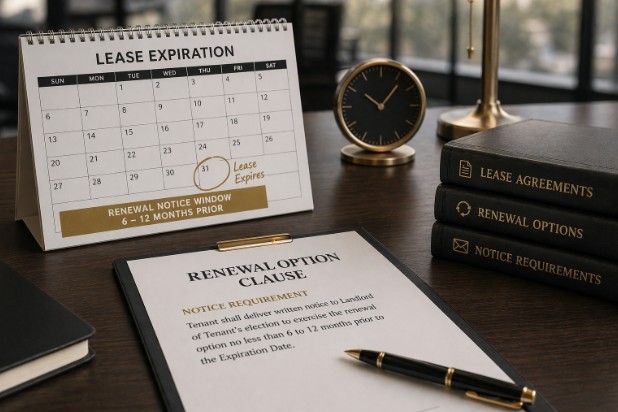
The notice requirement in a renewal option clause is the contractual provision that defines the written window and delivery method a tenant must use to notify the landlord of the intent to renew.
Most Alabama commercial leases require written notice 6–12 months before lease expiration. A tenant who misses that window forfeits the renewal option entirely — Alabama contract law provides no statutory cure period for a missed deadline to exercise a commercial lease option.
Missed notice deadlines are the most frequent mechanism by which Huntsville commercial tenants lose renewal rights. A business owner misses a calendar entry. A lease administrator delegates the tracking task without confirming the handoff.
Each scenario produces the same outcome: the tenant negotiates a new lease from scratch in a market that has tightened since the original lease was signed.
In Huntsville’s April 2026 commercial market — where defense and aerospace contract activity from programs at Redstone Arsenal and Cummings Research Park continues to compress vacancy in the South Huntsville and Research Park West submarkets — losing renewal leverage means a higher base rent, a shorter TI package, and fewer protective clauses in the replacement lease.
| Clause Component | Tenant-Favorable Language | Landlord Default and Risk |
| Notice window | 6 months prior to expiration | 12 months — longer window creates more calendar risk |
| Delivery method | Certified mail OR email with confirmed read receipt | Certified mail only — disputed delivery voids the option |
| Landlord confirmation | Must confirm receipt in writing within 10 business days | No confirmation required — tenant bears full proof burden |
| Failure to confirm | The option remains valid if the landlord fails to respond | Silence may be treated as an option rejection |
| Reminder obligation | The landlord delivers a written reminder 30 days before the window opens | No reminder — tenant must self-track |
Alabama Code § 35-9A-441 establishes a 30-day written notice requirement for residential month-to-month tenancies. Alabama commercial leases operate under contract law — every notice obligation is defined exclusively by the lease.
Anchoring dual delivery methods and a landlord-reminder obligation in the commercial lease letter of intent ensures that both provisions appear in the first lease draft, before the landlord’s attorney drafts the notice section in the landlord’s favor.
If you’re ready to get started, call us now!
Renewal rent in an Alabama commercial lease defaults to “fair market value” unless the tenant negotiates a specific rate formula before signing. Fair market value is determined at the time of renewal — not at lease signing — leaving an unprotected tenant unable to predict or budget for renewal rent in a tightening market.
Alabama Code § 11-80-8.1 expressly prohibits municipalities in Alabama from enacting rent control ordinances.
In Huntsville’s April 2026 market, where Class A office vacancy in the Cummings Research Park corridor has trended below 8%, fair market value at renewal will typically exceed the expiring base rent by a margin that an unprotected tenant cannot absorb without disrupting operating budgets.
| Rent Structure | Calculation Method | Tenant Risk | Best Application |
| Fixed renewal rent | Rate set in original lease, unchanged at renewal | Low | Stable tenants with long planning cycles |
| CPI-indexed | Annual increase tied to the U.S. Bureau of Labor Statistics CPI | Medium | Markets with predictable, moderate inflation |
| Fixed percentage increase | Base rent increases by a defined percentage, e.g., 3% annually | Medium-Low | Tenants requiring budget certainty over 5–10 year terms |
| Fair market value (FMV) | Appraised or negotiated against comparable transactions at renewal | High | Default landlord position — favors the landlord in rising markets |
| FMV with floor and ceiling | FMV applies but cannot fall below X% or exceed Y% of expiring rent | Medium | Acceptable compromise when the landlord resists a fixed formula |
Leasehold improvements create a specific FMV inflation risk. When a tenant installs specialized systems or custom buildout finishes, Alabama courts applying general contract principles have allowed landlords to include tenant-funded improvement value in the FMV calculation — inflating the renewal rate above what the unimproved space would command.
Tenants should negotiate express lease language excluding tenant-funded improvements from any FMV calculation, so you can protect your own capital investment from being used to justify a higher renewal rate.
The lease structure type affects total renewal cost beyond base rent. Understanding how CAM charges interact with renewal rent formulas is a required step in evaluating the total renewal-period cost, not an optional follow-on analysis.

Expansion rights are contractual lease provisions that give a commercial tenant priority access to additional space within the same building before the landlord markets that space to any third-party prospect.
Three legally distinct structures exist in Alabama commercial leasing: Right of First Offer (ROFO), Right of First Refusal (ROFR), and a direct Expansion Option.
A Right of First Offer (ROFO) is a contractual clause requiring the landlord to offer available adjacent space to the current tenant — including price and material terms — before listing the space to any outside prospect.
A tenant who accepts a ROFO offer negotiates directly with the landlord before the space enters the open market, preserving both pricing leverage and timeline control. ROFO is the strongest practical expansion right for tenants with a defined growth timeline.
A Right of First Refusal (ROFR) is a contractual clause that takes effect only after the landlord receives a qualifying third-party offer for adjacent space.
The current tenant then has the right to match those exact terms within a defined response window — typically 5–10 business days. ROFR is reactive: the tenant cannot initiate the process and must respond to a competitive offer under time pressure.
In Huntsville’s April 2026 market, where demand from defense contractors generates multiple competing offers for premium suites, a 5–10 business-day match window creates genuine execution risk.
An expansion option is a contractual clause that pre-designates a specific adjacent suite and gives the tenant the right to lease that space at a predetermined rent within a defined option period.
An expansion option removes the designated space from the landlord’s active marketing inventory — the landlord cannot lease it to any third party before the option expires. Landlords in high-absorption submarkets resist this clause; it remains negotiable where vacancy exceeds 12%.
| Right Type | Activation Trigger | Tenant Control | Landlord Obligation | Best Application |
| ROFO | The landlord decides to lease the adjacent space | High — first look before market | Must offer to the tenant at stated terms | Growing business with 12–24 month expansion timeline |
| ROFR | Landlord receives a qualifying third-party offer | Medium — must match the offer under time pressure | Activates only when an offer exists | Tenant wants protection, accepts reactive timing |
| Expansion Option | Contractual option period activates | Highest — pre-agreed space and rent | Designated space removed from marketing inventory | Tenant with a documented plan targeting a specific suite |
Huntsville tenants in the defense and aerospace sector — including contractors supporting Redstone Arsenal programs — frequently require expansion predictability as an operational requirement, because a U.S. Army or NASA contract award can trigger a 30–90 day headcount scaling decision.
Dean CRE’s tenant advisory services help tenants build the right language for expansion around documented, specific suites rather than undefined “available space” placeholders, so you can scale headcount without triggering a full building search.
All three expansion rights share one critical enforcement condition: the tenant must hold no active, uncured lease defaults at the time of exercise.
A tenant in an unresolved CAM reconciliation dispute may find that dispute cited as grounds to void an otherwise valid expansion right.
Landlord-drafted renewal options and expansion rights consistently contain conditions designed to narrow the tenant’s ability to exercise the clause.
The three most commonly enforced voiding conditions — good-standing requirements, personal-to-tenant restrictions, and demolition carve-outs — are negotiable at original lease execution and become non-negotiable after signing.
A good standing requirement voids the tenant’s renewal option or expansion right if the tenant is in default at the time of exercise. Landlord-drafted language frequently voids the option for any past default — including defaults cured months or years before the exercise date.
Tenants should negotiate “no uncured material default at the time of exercise” as the controlling standard, so you can exercise renewal and expansion rights after resolving any breach, rather than losing those rights to a historical payment record.
A personal-to-tenant restriction limits renewal options and expansion rights to the named tenant entity, voiding both protections upon any lease assignment, business sale, corporate restructuring, or merger.
This restriction appears as boilerplate in most North Alabama commercial leases and is most commonly discovered during buyer due diligence at the closing table of a business sale, not at lease signing.
Tenants should negotiate explicit assignability of all lease options upon any permitted assignment, so you can transfer renewal and expansion rights to an acquiring entity without triggering a new lease negotiation.
| Clause Trap | Landlord Default Language | Tenant-Favorable Alternative |
| Good standing | Any default, past or present, voids the option | No uncured material default at time of exercise |
| Personal restriction | Rights personal to the named tenant entity only | Rights transfer with any permitted lease assignment |
| Space condition | The landlord may modify the expansion space before delivery | Space delivered in the current physical condition |
| Demolition carve-out | All rights are void if the landlord redevelops the building | Rights survive unless the tenant receives 12 months’ notice plus relocation assistance |
| Sublet prohibition | Renewal void if the tenant has sublet any portion of the premises | Renewal is valid if the sublet was approved in writing by the landlord |
These five voiding conditions appear in commercial lease representation reviews across Huntsville, Madison, and Decatur commercial markets.
A voided renewal option on a 5,000-square-foot Huntsville suite in a tightened market can produce a rent increase that erases the value of the original tenant improvement allowance within 18 months.
If you’re ready to get started, call us now!
The Letter of Intent (LOI) stage — before the lease is drafted — is the optimal window for negotiating renewal options and expansion rights. A tenant who raises these terms for the first time during lease review negotiates against already-drafted landlord-favorable language under compressed timelines.
A tenant who anchors these terms in the LOI receives a first lease draft that reflects the tenant’s stated position.
The LOI must specify: the number of renewal options and duration of each term; the rent formula for each renewal period; the type of expansion right requested; and the specific adjacent suite or square footage targeted. An LOI that states “renewal rights to be discussed” produces clause language that a landlord’s attorney drafts narrowly in the landlord’s favor.
Complete LOI checklist for renewal and expansion terms:
Choosing a commercial broker in Huntsville who anchors these nine terms at the LOI stage is the direct mechanism separating a lease that protects the tenant through year ten from one that leaves every critical decision to the landlord’s discretion.
Engaging a commercial real estate attorney through the Alabama State Bar for final lease review confirms that the clause language is legally enforceable after the broker secures the commercial terms.
Tenant representation in Huntsville begins at the LOI stage — the commercial lease LOI is where leverage is highest, so you can lock in renewal and expansion protections before the landlord’s attorney drafts a single clause.
Alabama commercial tenants operate under one of the most landlord-favorable legal frameworks in the southeastern United States. Alabama commercial leases operate on contract law rather than statute — the lease document is the exclusive source of every right the tenant holds, including the right to renew, access adjacent space, or cap rent escalation.
Alabama Code § 11-80-8.1 prohibits municipalities in Alabama from enacting rent control ordinances. At the end of an Alabama commercial lease with no negotiated renewal clause, a landlord in Huntsville, Madison, or Decatur can decline to renew without cause, increase base rent by any amount, and impose entirely new lease conditions — with no statutory obligation to the departing tenant.
A negotiated renewal option in the original lease is the commercial tenant’s only legal protection against that outcome.
A holdover tenancy is the legal status that applies when a commercial tenant occupies leased space after expiration without executing a signed renewal, extension, or new lease.
Alabama courts applying commercial lease contract principles have held that holdover commercial tenants are liable for rent at 150–200% of the final base rent, plus potential accelerated eviction timelines, depending on the holdover language in the original lease.
Alabama Code § 35-9A-441 governs residential periodic tenancy notice baselines — Alabama commercial holdover consequences are governed entirely by the lease document.
Tenants should negotiate a holdover rent cap — 125–150% of the final month’s base rent for the first 60 days — to limit financial exposure during any gap between expiration and execution of a replacement agreement.
Monitoring Huntsville commercial real estate market trends during the 12–18 months before expiration provides the market intelligence needed to assess holdover likelihood.
Tenants who avoid common commercial real estate mistakes in Alabama — specifically signing without representation and accepting landlord-form leases without clause-level negotiation — consistently pay lower rent and carry fewer holdover liabilities over the full lease term.
A tenant broker negotiates renewal options and expansion rights as standard deliverables in every lease engagement — not optional add-ons. A landlord’s broker holds no obligation to raise renewal options, holdover caps, or expansion rights on the tenant’s behalf.
A dual-agency broker managing both sides produces compromise outcomes rather than tenant-optimal outcomes.
| Negotiation Factor | With Dedicated Tenant Broker | Without Broker or With Dual-Agency Broker |
| Renewal option | Negotiated at the LOI stage with a defined term, formula, and notice window | Frequently omitted or included as vague boilerplate |
| Expansion rights | ROFO or ROFR requested in the LOI with a specific space identified | Rarely raised before lease signing |
| Notice deadline tracking | Calculated from the lease execution date | Tenant’s sole responsibility |
| FMV rent disputes | An arbitration mechanism is built into the renewal clause | FMV was left to the landlord’s appraiser without a defined dispute process |
| Option assignability | Negotiated before signing | Discovered as a restriction during business sale due diligence |
| TI allowance at renewal | Dollar amount negotiated in original lease | Subject to the landlord’s unilateral discretion |
| Holdover rent cap | 125–150% cap negotiated as standard clause | Absent — tenant exposed to 200% rate or higher |
Dean CRE, led by principal broker Dean Greer, CCIM, provides exclusive tenant representation across Huntsville and North Alabama’s commercial real estate market. Dean Greer holds the Certified Commercial Investment Member (CCIM) designation from the CCIM Institute and brings documented transaction experience in the defense contracting, aerospace research, and professional services sectors that drive leasing demand in Huntsville.
Every Dean CRE lease engagement includes LOI-stage clause negotiation, analysis of current market comparables, and a structured audit of renewal and expansion language before any document is signed.
If your North Alabama commercial lease is approaching expiration, or if you are entering initial negotiations on a new commercial space in the Huntsville metro, contact Dean CRE to review your renewal option and expansion rights position before the landlord sets the terms.
What is a renewal option in a commercial lease?
A renewal option is a contractual clause that grants a commercial tenant the right to extend the lease for an additional defined term at a predetermined or formula-based rent. The tenant must deliver written notice within a specified window — typically 6–12 months before expiration — or the option is permanently forfeited.
What is the difference between a lease renewal and a lease extension?
A lease extension continues the existing lease under its original terms, preserving all previously negotiated protections. A lease renewal creates a new document at expiration, and clauses personal to the original parties — including expansion rights and rent caps — do not carry over unless the tenant’s attorney expressly includes them.
What is the difference between a Right of First Offer and a Right of First Refusal?
A Right of First Offer requires the landlord to offer available adjacent space to the tenant — at stated price and terms — before marketing it publicly. A Right of First Refusal activates only after the landlord receives a qualifying third-party offer, requiring the tenant to match those exact terms within a short response window. ROFO gives the tenant earlier access and eliminates time pressure.
Can a landlord in Alabama refuse to renew a commercial lease?
Yes. Alabama imposes no just-cause eviction requirement and no mandatory renewal obligation on commercial landlords. A landlord whose tenant holds no negotiated renewal option can decline to renew without cause, increase rent by any amount, and offer the space to a new tenant — with no statutory liability.
When is the best time to negotiate renewal options and expansion rights?
The LOI stage — before the lease is drafted — is the optimal window. A tenant who anchors renewal duration, rent formula, expansion right type, and notice window in the LOI receives a first lease draft reflecting those terms rather than the landlord’s default language.
What happens if a commercial tenant misses the renewal notice deadline?
Missing the written renewal notice deadline voids the option entirely under Alabama contract law. The tenant loses the right to extend on previously negotiated terms and must renegotiate from scratch or vacate. No statutory cure period applies to missed deadlines under commercial lease options in Alabama.
What is a holdover tenancy, and why does it create financial risk in Alabama?
A holdover tenancy occurs when a commercial tenant occupies the premises after the expiration of the lease without a signed renewal, extension, or new lease. Alabama commercial lease practice permits landlords to charge 150–200% of the final base rent rate for holdover periods. Negotiating a 125–150% holdover rent cap for the first 60 days directly limits that exposure.
What does “good standing” mean in a renewal or expansion clause?
A good-standing requirement makes the tenant’s right to exercise a renewal or expansion option contingent on having no active default at the time of exercise. Tenants should negotiate “no uncured material default at the time of exercise” as the controlling standard, so past-cured breaches cannot be used to void a current option exercise.
Should expansion rights be assignable when a business is sold?
Yes. Expansion rights personal to the named entity terminate in any business sale, merger, or restructuring — a restriction most commonly discovered during buyer due diligence rather than at lease signing. Tenants should negotiate explicit assignability of all lease options so those rights transfer to an acquiring entity without triggering a new lease negotiation.
How is renewal rent calculated when the lease says “fair market value”? Fair market value renewal rent is appraised or negotiated against comparable transactions at the time of renewal — not at lease signing. In Huntsville’s April 2026 market, where commercial vacancy has trended below 8% in key submarkets, FMV at renewal will typically exceed the expiring base rent. Tenants should negotiate an FMV formula with a defined floor and ceiling to cap renewal costs within a range that supports multi-year financial planning.
What is an expansion option in a commercial lease?
An expansion option is a contractual clause that pre-designates a specific adjacent suite and gives the tenant the right to lease that space at pre-agreed rent within a defined option period. Unlike ROFO or ROFR, an expansion option removes the designated space from the landlord’s active marketing inventory for the entire option period.
Do Alabama commercial leases automatically include renewal options?
No. Alabama commercial leases operate exclusively on contract law — no statute requires a landlord to include renewal options, expansion rights, rent caps, or holdover protections. A tenant who signs a standard landlord-form lease in Huntsville, Madison, or Decatur without broker representation receives none of these protections unless each clause was independently negotiated before signing.